
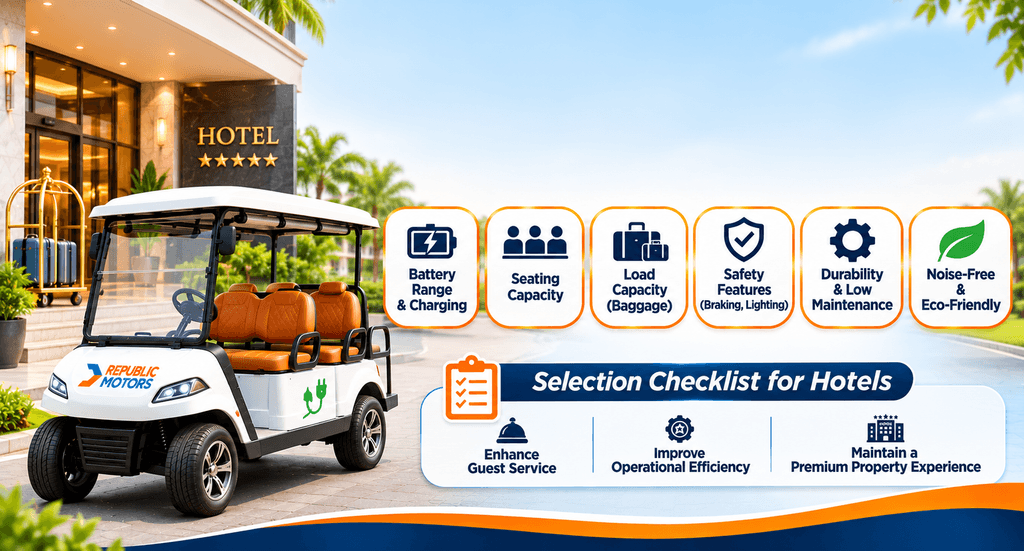
Electric golf carts for hotels provide a convenient way to transport guests, luggage, staff, and supplies across large hotel properties. Before purchasing, hotel owners and hospitality managers should evaluate seating capacity, luggage space, battery configuration, driving range, load capacity, safety features, charging requirements, and maintenance support. The right model depends on the hotel’s property size, daily transportation needs, and operating schedule.
Republic Motors, an electric vehicle manufacturer in India, offers electric golf cart solutions for different commercial applications. Hotels can evaluate its passenger- and utility-oriented configurations based on guest transportation, housekeeping, and internal logistics needs.
Why Do Hotels Need Electric Golf Carts?
Large hotels often have multiple buildings, guest rooms, restaurants, gardens, parking areas, event spaces, and recreational facilities. Walking between these locations can be inconvenient for guests, especially those carrying luggage or needing mobility assistance.
Electric golf carts can support internal transportation by helping hotels move guests and staff between designated locations.
Some common hotel applications include:
- Guest pickup and drop-off within the property.
- Transportation between rooms and reception areas.
- Luggage movement.
- Internal staff transportation.
- Movement of housekeeping supplies.
- Maintenance and facility operations.
- Transportation around gardens and recreational areas.
- Movement across large hospitality premises.
The vehicle configuration should match the intended task. A passenger golf cart and a utility golf cart may serve different operational requirements.
7 Important Factors to Consider When Buying Electric Golf Carts for Hotels
1. Choose the Right Seating Capacity
Seating capacity is one of the first factors hotels should evaluate. The ideal configuration depends on the number of guests who regularly need transportation together.
Consider these general applications:
2-Seater Golf Cart: Suitable for limited passenger movement, individual guest assistance, or specific hotel operations where a smaller configuration is sufficient.
4-Seater Golf Cart: Can support guest transportation for small groups and routine movement around hotel premises.
6-Seater Golf Cart: May suit hotels that regularly transport larger guest groups or staff together.
8-Seater Golf Cart: Can be considered for properties with higher group transportation requirements.
However, seating capacity alone should not determine the purchase. Hotels must also verify the permitted payload and consider the combined weight of passengers and luggage.
2. Evaluate Luggage and Storage Requirements
Hotel guests often travel with suitcases, handbags, and other personal belongings. Therefore, luggage arrangements should be considered before choosing a golf cart.
Ask the manufacturer:
- Is dedicated luggage space available?
- Can additional luggage storage be configured?
- What is the permitted combined passenger and cargo weight?
- How should luggage be secured during transportation?
- Is a separate utility cart more suitable for baggage movement?
Hotels with frequent airport transfers or large group arrivals may benefit from considering separate passenger and luggage transportation arrangements.
Avoid placing luggage on passenger seats or exceeding the manufacturer’s permitted payload.
3. Check Battery Type and Charging Requirements
Battery configuration is an important consideration for hotels because golf carts may operate throughout the day.
Before purchasing, compare:
- Battery chemistry, such as lead-acid or lithium-ion.
- Battery voltage and capacity.
- Manufacturer-specified charging time.
- Battery warranty.
- Charging equipment compatibility.
- Battery maintenance requirements.
- Available battery protection features.
Lithium-ion batteries may offer advantages in certain operating conditions, while lead-acid batteries may suit other purchasing and maintenance requirements. The best choice depends on the hotel’s budget, operating schedule, charging arrangements, and expected vehicle usage.
Hotels should also ask about the battery management system (BMS) when evaluating lithium-ion configurations.
4. Understand the Real-World Driving Range
A hotel’s electric golf cart should have sufficient range to support its expected daily transportation schedule.
However, advertised range and actual operating range may differ depending on:
- Passenger and luggage load.
- Battery capacity and condition.
- Driving speed.
- Route length and terrain.
- Frequency of stops and starts.
- Tyre pressure.
- Driving habits.
- Operating conditions.
Instead of relying only on a brochure’s range figure, hotels should estimate the distance covered during a typical working day.
Ask the manufacturer for the expected range under clearly defined operating conditions and discuss whether the vehicle can meet the hotel’s daily requirements.
5. Evaluate Safety Features
Guest transportation requires careful attention to vehicle safety.
Hotels should evaluate the availability and suitability of:
- Braking system.
- Seat belts, where provided.
- Headlights and taillights.
- Turn indicators.
- Rear-view mirrors.
- Tyre quality and condition.
- Steering response.
- Passenger seating and handholds.
- Speed-control configuration.
- Reverse warning features, where available.
The exact safety equipment may differ between models. Hotels should confirm the installed features and relevant operating recommendations with the manufacturer.
Driver training, designated routes, speed limits, and regular inspections are also important parts of hotel golf cart safety.
6. Consider the Hotel’s Property and Terrain
Not every hotel has the same layout or operating environment.
A golf cart used in a compact hotel property may have different requirements from one operating across a large resort with gardens, pathways, slopes, and multiple buildings.
Before selecting a model, assess:
- Total property size.
- Width of internal pathways.
- Turning space.
- Slope and surface conditions.
- Distance between major guest locations.
- Passenger pickup and drop-off points.
- Charging station location.
Share these details with the manufacturer so the vehicle configuration can be evaluated for the actual operating environment.
7. Compare Maintenance and After-Sales Support
A golf cart used regularly in hotel operations requires a planned maintenance schedule.
Before purchasing, hotels should understand:
- Recommended servicing intervals.
- Battery maintenance requirements.
- Brake and tyre inspection.
- Availability of spare parts.
- Warranty coverage.
- Service support and response arrangements.
- Availability of technical assistance.
For hotels operating multiple vehicles, preventive maintenance and service records can help manage fleet reliability and reduce unexpected interruptions.
Passenger Golf Cart vs Utility Golf Cart for Hotels
Hotels may need different vehicle configurations for guest transportation and internal operations.
| Requirement | Passenger golf cart | Utility golf cart |
| Main purpose | Guest and staff transportation | Supplies, luggage, and equipment |
| Seating | Multiple passenger seats | Depends on configuration |
| Storage | Depends on model | Designed around utility requirements |
| Common use | Reception-to-room transfers | Housekeeping and maintenance |
| Selection priority | Seating and passenger payload | Cargo space and permitted payload |
A hotel should not assume that one vehicle can efficiently handle every transportation task. Separate passenger and utility configurations may be more practical for properties with diverse operating requirements.
How Many Golf Carts Does a Hotel Need?
The number of golf carts required depends on property size, guest occupancy, daily transportation frequency, and operating hours.
Hotels should evaluate:
- Number of guests requiring internal transportation.
- Average daily pickup and drop-off frequency.
- Distance between important locations.
- Peak check-in and check-out periods.
- Number of staff members using internal transportation.
- Housekeeping and maintenance requirements.
- Time available for charging and routine maintenance.
For example, a hotel with frequent group arrivals may need more passenger transportation capacity during peak hours. A resort with a large property may need vehicles assigned to different operating zones.
A practical approach is to monitor daily transportation demand before deciding the final fleet size.
Electric Golf Cart Buying Checklist for Hotels
Before placing an order, use this checklist to compare available models.
| Evaluation area | What hotels should check |
| Seating capacity | 2-, 4-, 6-, or 8-seater requirement |
| Payload | Combined passenger and cargo weight |
| Luggage space | Storage arrangement and permitted load |
| Battery | Type, capacity, and warranty |
| Driving range | Expected range under actual conditions |
| Charging | Charging time and infrastructure |
| Safety | Brakes, lights, mirrors, and restraints |
| Terrain | Pathways, slopes, and surface conditions |
| Maintenance | Service schedule and spare parts |
| Warranty | Battery and vehicle warranty terms |
| Customisation | Branding, storage, and utility requirements |
| After-sales | Technical and service support |
What Affects the Cost of Electric Golf Carts for Hotels?
The purchase price of an electric golf cart depends on several factors, including seating capacity, battery configuration, vehicle design, accessories, and customisation.
Hotels should request quotations based on their actual requirements rather than comparing prices without considering specifications.
Also evaluate the total cost of ownership, which may include:
- Initial vehicle purchase price.
- Electricity and charging expenses.
- Battery replacement, where applicable.
- Scheduled servicing.
- Spare parts.
- Tyre replacement.
- Warranty and service support.
Comparing these costs over the expected ownership period provides a more useful picture than looking at the initial price alone.
Why Consider Republic Motors for Hotel Electric Golf Carts?
Republic Motors provides electric golf cart solutions for different commercial transportation requirements. Its product range includes 2-, 4-, 6-, and 8-seater configurations that hotels can evaluate according to passenger requirements and property operations.
Before selecting a model, hotel buyers should discuss:
- Number of passengers transported daily.
- Luggage and storage requirements.
- Expected daily operating distance.
- Battery and charging preferences.
- Property layout and terrain.
- Required safety features.
- Customisation and branding needs.
- Warranty and after-sales support.
Hotels can explore the Republic Motors product range and discuss their requirements through the official contact page.
Conclusion
Selecting electric golf carts for hotels requires a clear understanding of guest transportation, luggage movement, property layout, and daily operating requirements. Hotels should compare seating capacity, permitted payload, battery configuration, driving range, safety features, charging arrangements, and maintenance support before purchasing.
Whether you operate a hotel, resort, or large hospitality property, choosing a suitable vehicle configuration can help organise internal transportation more effectively. Republic Motors offers multiple electric golf cart configurations that hotel businesses can evaluate according to their operational needs.