
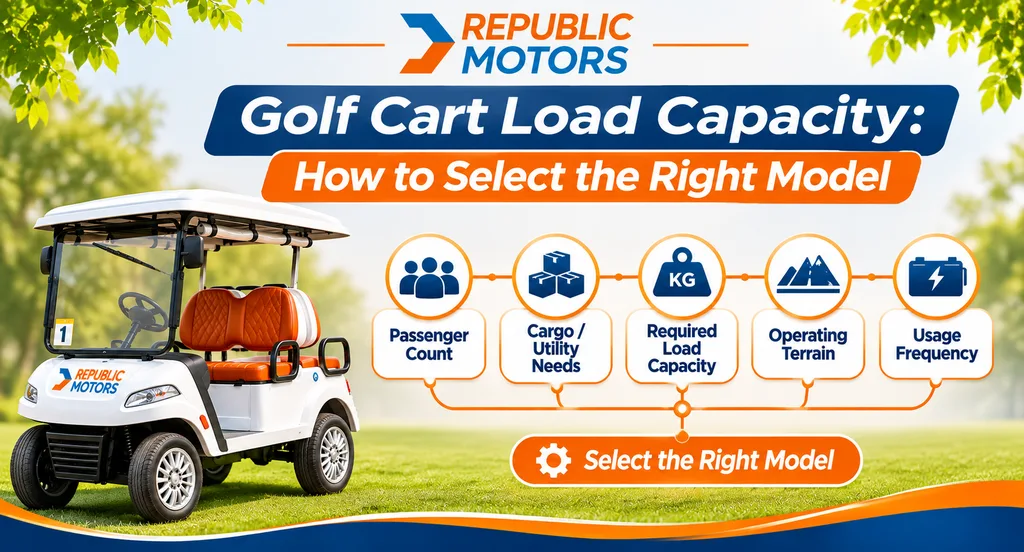
Choosing a golf cart is not about how many people can sit in it or what it looks like. The ability to carry weight is just as important because it shows how much weight the vehicle can safely move. Before buying a golf cart, companies should think about how much people weigh, what luggage they bring, what equipment they need, and what conditions the cart will be used in every day.
Republic Motors, a company that makes vehicles in India, has electric golf cart options for different types of businesses. When looking at any model, people should compare the weight limits the maker says the cart can carry with what they need to move. They should not just pick a cart because it has seats.
What exactly is the weight limit for a golf cart?
The weight limit for a golf cart is the weight the vehicle is built and approved to carry, based on what the manufacturer says. Depending on the model, this can include people, bags, tools, equipment, and other things to carry.
People should know the difference between three key terms:
- Passenger capacity: How many people the golf cart is made for.
- Payload capacity: The weight of people and things the cart can carry.
- Vehicle weight: How much the cart itself weighs. This is not the same as the weight it can carry.
For example, a golf cart that holds six people is designed for six people. That does not mean it can carry six people and heavy bags at the same time. The weight limit for the load must be checked separately.
Why Is Load Capacity Important When Buying a Golf Cart?
Picking a golf cart that does not match the weight limit can change how it works, how it handles, how it stops, and how long it lasts. Companies should think about what they need before deciding on a model.
1. Transporting people
Hotels, resorts, golf courses, and schools often use golf carts to move people. The total weight of the people should stay under the limit the manufacturer says.
A cart made for moving people should be chosen based on both how many people there are and how much they weigh together.
2. Moving bags and things
Some businesses need golf carts to carry luggage, tools, supplies, or other things.
In those cases, people should look at how much space’s there is for bags, the weight limit, and whether the cart is made especially for carrying things.
3. How the cart works
Using a golf cart beyond its weight limit can make the motor, battery, tires, suspension, and brakes work harder.
Much weight can change how fast it goes, how well it climbs, how far it takes to stop, and how much energy it uses. Staying under the maker’s limits helps the cart work well.
4. Safety and how steady the cart is
A cart that’s too heavy can be harder to control especially when turning, going up hills or stopping.
If the weight is not spread out right the cart can become unstable. People should put the weight according to what the manufacturer says.
How to Calculate the Load Requirement for a Golf Cart
Before choosing a model, businesses should estimate their expected passenger and cargo weight.
A simple calculation is:
Total Required Payload = Combined Passenger Weight + Cargo Weight + Additional Carried Equipment
For example, consider a business that needs to transport four passengers and some luggage.
| Requirement | Illustrative weight |
| Passenger 1 | 70 kg |
| Passenger 2 | 75 kg |
| Passenger 3 | 65 kg |
| Passenger 4 | 80 kg |
| Luggage | 40 kg |
| Total estimated payload | 330 kg |
This example shows how passenger and luggage weight contribute to the total load. The figures are illustrative, not a specification or recommended capacity for any particular golf cart.
Once the requirement is calculated, compare it with the vehicle’s official payload rating. Also check whether the manufacturer includes passengers, cargo, accessories, or other carried equipment in that rating.
Do not assume that a vehicle can safely carry the calculated weight simply because it has enough seats.
Passenger Capacity vs Load Capacity: What Is the Difference?
Passenger capacity and load capacity are related, but they are not interchangeable.
| Comparison | Passenger capacity | Load capacity |
| Meaning | Number of occupants | Permitted weight carried |
| Measurement | Number of seats/passengers | Kilograms (kg) |
| Main consideration | Seating arrangement | Combined passenger and cargo weight |
| Important for | Passenger transportation | Passenger and utility applications |
For example, a four-seater golf cart may have four passenger seats, but buyers must still confirm its maximum permitted payload. Similarly, an eight-seater model should not be assumed to carry eight passengers plus additional luggage without checking its approved load specifications.
Factors to Consider When Selecting the Right Golf Cart Load Capacity
1. Number of Passengers
Start by identifying how many people will normally travel together. Consider regular occupancy rather than selecting a model only for occasional requirements.
For hotels, resorts, and campuses, passenger movement patterns can help determine whether a two-, four-, six-, or eight-seater configuration is appropriate.
2. Average Passenger Weight
The total passenger weight matters more than the number of seats alone.
Businesses should estimate realistic passenger weights when calculating the required payload. The vehicle must remain within its manufacturer’s specified limits even when all seats are occupied.
3. Luggage and Cargo Requirements
If passengers travel with luggage, or staff carry equipment and supplies, these weights must also be included.
For regular cargo transportation, a dedicated utility golf cart may be more suitable than a passenger-focused configuration.
4. Terrain and Operating Conditions
Consider where the golf cart will operate.
Flat pathways, uneven surfaces, slopes, and different ground conditions can affect vehicle performance. Buyers should discuss the intended terrain and operating conditions with the manufacturer rather than assuming that the maximum payload will perform identically in every environment.
5. Battery and Motor Specifications
The battery and motor are important parts of an electric golf cart’s performance system.
Buyers should compare the manufacturer’s specified motor, battery configuration, and operating recommendations. They should also ask whether the selected vehicle configuration is suitable for the expected passenger or cargo load.
6. Tyres, Brakes, and Suspension
Tyres, braking systems, and suspension components contribute to vehicle control and stability.
Check the manufacturer’s load recommendations for these components and confirm that the selected configuration is appropriate for the intended application.
7. Daily Operating Hours
A golf cart used for occasional guest transportation may have different requirements from a vehicle operating throughout the day.
Businesses should consider daily usage, passenger frequency, route length, charging arrangements, and the expected load during normal operations.
Which Golf Cart Load Capacity Is Suitable for Different Industries?
Different industries have different passenger and cargo transportation requirements. The right configuration depends on the actual workload and the manufacturer’s approved specifications.
Hotels and Resorts
Hotels and resorts may use golf carts to transport guests, luggage, and staff within their properties.
A passenger-focused golf cart may be suitable for guest transportation, while a separate utility configuration may be preferable for housekeeping supplies, maintenance equipment, and other materials.
Golf Courses
Golf courses may require carts for players, staff, and equipment movement.
Buyers should consider passenger requirements, golf equipment, route conditions, and the permitted combined payload when selecting a vehicle.
Hospitals and Healthcare Facilities
Hospitals and large healthcare campuses may use golf carts for internal transportation of staff, visitors, or supplies.
The selected model should match the intended use, passenger requirements, accessibility needs, and site conditions.
Universities and Educational Campuses
Large campuses may need electric golf carts for staff, visitors, and internal transportation.
A suitable model should be selected according to passenger frequency, route distance, operating hours, and total expected load.
Factories and Warehouses
Industrial facilities may require utility golf carts for carrying tools, materials, and maintenance equipment.
In these environments, buyers should pay particular attention to cargo capacity, load distribution, vehicle configuration, and site conditions.
Passenger Golf Cart vs Utility Golf Cart: Which Should You Choose?
The right vehicle depends on whether the primary requirement is transporting people or carrying materials.
| Feature | Passenger golf cart | Utility golf cart |
| Primary purpose | Passenger transportation | Cargo and equipment movement |
| Seating arrangement | Multiple passenger seats | Depends on vehicle configuration |
| Cargo arrangement | Limited space, depending on model | Designed around utility requirements |
| Typical applications | Hotels, resorts, campuses | Factories, warehouses, maintenance |
| Selection priority | Seats and passenger payload | Cargo payload and load area |
If your business regularly carries both passengers and heavy equipment, discuss the requirement with the manufacturer. A suitable vehicle configuration should be selected instead of exceeding the permitted load of a passenger model.
Common Mistakes to Avoid When Selecting Golf Cart Load Capacity
Before purchasing a golf cart, avoid these common mistakes:
- Choosing only by seating capacity: More seats do not automatically mean a higher permitted payload.
- Ignoring luggage weight: Bags, tools, and accessories also contribute to the total load.
- Assuming all models have the same specifications: Load limits can vary by model and configuration.
- Overlooking terrain: Slopes and uneven surfaces can affect vehicle performance under load.
- Ignoring weight distribution: Unevenly placed passengers or cargo may affect stability and handling.
- Not checking manufacturer documentation: Always request the official payload and component load specifications.
- Using passenger carts for unsuitable cargo applications: A dedicated utility vehicle may be more appropriate for regular material transportation.
Why Discuss Load Capacity with Republic Motors Before Ordering?
Republic Motors provides electric golf cart solutions for different passenger and commercial transportation requirements. Its product range includes multiple seating configurations, including 2-, 4-, 6-, and 8-seater options.
Before placing an order, businesses should share details such as:
- Required passenger seating capacity.
- Expected combined passenger weight.
- Luggage, equipment, or cargo weight.
- Intended application and operating environment.
- Daily operating hours and route conditions.
- Any special body, storage, or utility requirements.
This information helps the manufacturer understand the intended application and discuss a suitable vehicle configuration.
Explore the Republic Motors product range or contact the team through the official contact page to discuss your requirements.
Conclusion
Selecting the right golf cart load capacity requires more than counting the available seats. Businesses should calculate passenger and cargo weight, understand the vehicle’s permitted payload, and consider terrain, daily usage, battery, motor, tyres, and braking requirements.
Whether you need a golf cart for a hotel, resort, golf course, campus, factory, or warehouse, compare the actual load requirement with the manufacturer’s official specifications before ordering. Republic Motors offers electric golf cart configurations for different commercial applications, helping businesses discuss their transportation needs and evaluate a suitable model.
One Response