
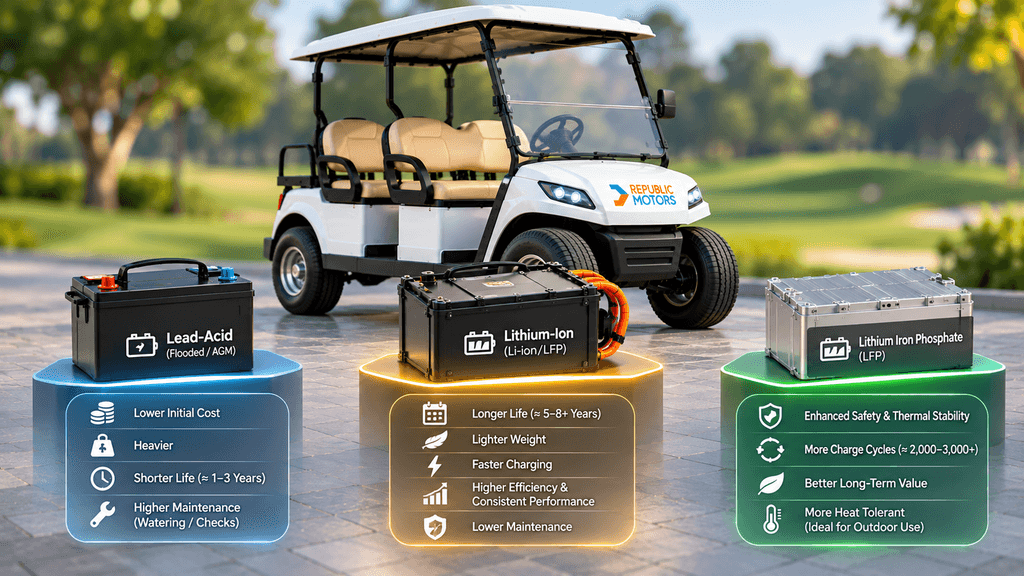
Electric golf cart batteries determine how the vehicle stores energy, how it is charged, and how reliably it can operate throughout the working day. The most important battery types for buyers to compare are lead-acid and lithium-ion. The right choice depends on upfront budget, daily usage, charging time, maintenance requirements, battery life, vehicle compatibility, and total cost of ownership.
Republic Motors provides electric golf cart solutions for commercial and institutional applications, where battery selection should match the vehicle configuration and actual operating requirements. Before purchasing an electric golf cart, buyers should understand the differences between battery technologies instead of comparing price alone.
What Are the Main Types of Electric Golf Cart Batteries?
Electric golf carts commonly use two broad battery technologies: lead-acid and lithium-ion. Lead-acid batteries are an established option, while lithium-ion batteries may offer advantages in weight, maintenance, and usable energy, depending on the battery design.
The specific battery chemistry, capacity, voltage, and charging system can vary between golf cart models. Buyers should always verify the specifications of the exact vehicle they intend to purchase.
1. Lead-Acid Batteries
Lead-acid batteries store electrical energy through chemical reactions involving lead-based electrodes and an electrolyte. They have been widely used in golf carts and other battery-powered vehicles.
There are different types of lead-acid batteries, including flooded lead-acid and sealed designs such as AGM (Absorbent Glass Mat). Their maintenance requirements and charging characteristics differ.
Potential advantages:
- Often have a lower initial purchase cost than comparable lithium-ion systems.
- Are an established battery technology with familiar servicing practices.
- May be suitable for businesses with predictable operating schedules and sufficient charging time.
- Can be appropriate where the purchase budget is a major consideration.
Points buyers should consider:
- Flooded batteries require routine checks and maintenance according to the manufacturer’s instructions.
- Battery weight can affect the vehicle’s overall weight and energy consumption.
- Charging may take longer depending on battery capacity and charger output.
- Battery life depends on usage, charging practices, depth of discharge, and maintenance.
- Replacement and maintenance costs should be included in the ownership budget.
Lead-acid batteries can be suitable for some commercial operations, but buyers should evaluate their complete operating requirements rather than relying only on the initial price.
2. Lithium-Ion Batteries
Lithium-ion is a family of rechargeable battery technologies used in many modern electric vehicles and equipment. The exact chemistry matters; lithium iron phosphate (LFP or LiFePO4), for example, is one type of lithium-ion battery.
A lithium-ion battery system designed for a golf cart may include a battery management system (BMS). Depending on its design, the BMS monitors battery conditions and helps protect the pack within specified operating limits.
Potential advantages:
- Often weighs less than a comparable lead-acid battery system.
- May provide more usable energy for a given nominal capacity, depending on the battery specifications.
- Generally requires less routine maintenance than flooded lead-acid batteries.
- May support faster charging when the battery and charger are designed for it.
- Can offer a long service life under suitable operating and charging conditions.
Points buyers should consider:
- Initial purchase cost may be higher.
- Battery chemistry, BMS functionality, and system quality vary.
- The charger must be compatible with the battery.
- Operating temperature and storage requirements must be followed.
- Replacement, warranty, and service arrangements should be confirmed before purchase.
Lithium-ion batteries can be attractive for frequent-use applications, but their suitability depends on the specific battery pack, vehicle design, usage pattern, and overall cost.
Lead-Acid vs Lithium-Ion Golf Cart Batteries
The following comparison highlights common differences. Actual performance depends on the battery model and the complete vehicle system.
| Comparison factor | Lead-acid | Lithium-ion |
| Initial cost | Often lower | Often higher |
| Weight | Generally heavier | Generally lighter |
| Routine maintenance | Flooded types require periodic maintenance; sealed types differ | Typically lower routine maintenance |
| Charging time | Depends on capacity and charger; can be relatively long | May be shorter with a compatible system |
| Usable energy | Depends on battery design and discharge limits | Can offer a higher usable proportion of rated capacity, depending on design |
| Service life | Strongly affected by discharge depth, maintenance and charging | Strongly affected by chemistry, temperature, charging and usage |
| Battery management | Depends on battery and system design | Often includes a BMS |
| Replacement cost | Usually lower per battery, but compare the complete pack | Usually higher initially; compare the full replacement cost |
| Best-fit considerations | Budget-sensitive or predictable operating requirements | Frequent use, weight considerations, or reduced routine maintenance |
No battery type is automatically best for every golf cart. Buyers should compare verified specifications and operating costs for the actual models under consideration.
7 Factors to Compare Before Choosing an Electric Golf Cart Battery
1. Capacity and Usable Energy
Battery capacity indicates how much energy a battery can store. It may be expressed in ampere-hours (Ah), while energy capacity is commonly expressed in kilowatt-hours (kWh).
When comparing batteries, check both voltage and capacity. For a battery system with compatible nominal voltage and capacity ratings, nominal energy can be estimated as:
Nominal energy (Wh) = nominal voltage (V) × capacity (Ah)
Divide watt-hours by 1,000 to convert the result into kilowatt-hours.
For example, a battery’s nominal energy rating does not tell you how much energy is safely usable in daily operation. The usable amount depends on the battery chemistry, management system, and manufacturer’s recommended operating limits.
Businesses should estimate daily energy demand from actual routes, passenger or cargo loads, terrain, and operating hours.
2. Charging Time and Charger Compatibility
Charging time affects how quickly a golf cart can return to service. It depends on battery capacity, remaining charge, charger output, battery condition, temperature and the battery’s charging limits.
Before purchasing, ask:
- What charger is supplied with the vehicle?
- How long does charging typically take under the manufacturer’s stated conditions?
- Is a suitable charging point available at the facility?
- Can the vehicle be charged during breaks or between shifts?
- Are any special electrical installation requirements applicable?
Never assume that a charger designed for one battery technology is suitable for another. The battery, charger, and vehicle electrical system must be compatible.
3. Battery Lifespan and Replacement Frequency
Battery lifespan is affected by more than its chemistry. Depth of discharge, operating temperature, charging practices, storage conditions, and maintenance all influence long-term performance.
Ask the supplier how battery life is specified. Some manufacturers provide cycle-life ratings under defined test conditions. These ratings should not be treated as a guaranteed number of years in every real-world application.
Also confirm the warranty period, exclusions, capacity-retention conditions, and availability of replacement batteries.
4. Maintenance Requirements
Maintenance needs differ between battery types and designs.
Flooded lead-acid batteries may require electrolyte-level checks and other manufacturer-prescribed maintenance. Sealed lead-acid batteries have different requirements. Lithium-ion systems generally require less routine battery maintenance, but still need correct charging, inspection, and storage.
Regardless of battery type, operators should inspect charging connectors and visible cables, look for signs of damage, and follow the vehicle’s service schedule. Battery repairs should be handled by qualified personnel.
5. Initial Price vs Total Cost of Ownership
The cheapest battery at purchase may not be the least expensive option over the vehicle’s service life.
Total cost of ownership can include:
- Initial battery purchase cost.
- Charger and installation costs.
- Electricity used for charging.
- Scheduled maintenance.
- Potential downtime during charging or servicing.
- Replacement battery costs.
- Warranty coverage and service availability.
For a business fleet, compare these costs over the same evaluation period and under similar daily usage assumptions.
A battery with a higher upfront price may be financially reasonable in a high-utilisation operation, but the result depends on actual costs and performance rather than battery chemistry alone.
6. Vehicle Compatibility and Safety
Battery voltage, dimensions, weight, connectors, charging requirements and control-system compatibility must match the golf cart.
Replacing a lead-acid battery with a lithium-ion system is not necessarily a simple battery swap. The vehicle may require a compatible battery management system, charger, wiring, mounting arrangement or other changes approved by the manufacturer.
Check the following before making a decision:
- Battery voltage and specified capacity.
- Permitted battery dimensions and weight.
- Charger and controller compatibility.
- Battery mounting and electrical connections.
- Protection and safety provisions.
- Manufacturer approval for the proposed configuration.
Do not modify the battery system without the vehicle manufacturer’s approval and qualified technical support.
7. Warranty and After-Sales Support
A battery’s practical value also depends on the support available after purchase.
Ask the supplier about battery warranty coverage, the process for diagnosing faults, service availability, replacement timelines, and the availability of compatible spare parts. Clarify whether the battery and charger have separate warranty terms.
For commercial users, downtime can affect transportation schedules and operations. Reliable service arrangements should therefore be part of the purchase decision.
Which Electric Golf Cart Battery Is Better for Commercial Use?
The better option depends on how the golf cart will be used.
Budget-sensitive operations: Lead-acid may be worth evaluating where the initial cost is important, usage is predictable, and the business can accommodate its charging and maintenance requirements.
Frequent daily use: Lithium-ion may be worth considering where reduced routine maintenance, lower battery weight, or greater usable energy is valuable. Confirm the actual pack specifications and expected operating costs.
Hotels and resorts: Consider passenger demand, daily travel distance, charging windows, and vehicle availability during peak periods.
Campuses and townships: Estimate the distance covered per day and assess how the cart will be charged between operating periods.
Industrial facilities: Pay close attention to load requirements, route conditions, duty cycles, safety provisions, and the battery system’s suitability for the operating environment.
These are evaluation guidelines rather than universal rules. The appropriate choice must be based on the exact vehicle and the conditions in which it will operate.
Questions to Ask Before Buying a Golf Cart Battery
Before finalising an electric golf cart purchase, ask the manufacturer or supplier:
- Which battery chemistry and model are installed?
- What are the battery’s nominal voltage, Ah rating, and energy capacity?
- What usable energy is available under the manufacturer’s recommended operating limits?
- What charging time should be expected with the supplied charger?
- What range can be expected under clearly stated operating conditions?
- What maintenance does the battery require?
- What is the battery warranty, and what conditions or exclusions apply?
- How and where can a compatible replacement battery be obtained?
- Is the battery system suitable for the intended daily duty cycle?
- What is the estimated total ownership cost over the planned usage period?
Getting clear answers helps businesses compare complete solutions instead of making decisions based on a single specification.
Electric Golf Cart Battery Options at Republic Motors
Republic Motors offers electric golf cart solutions for commercial and institutional applications. Businesses evaluating a vehicle should consider the intended passenger capacity, daily operating requirements, charging arrangements, and the specifications of the offered battery system.
You can explore the Republic Motors product range and review the RM Series 6S and RM Series 8S product pages.
For a purchase decision, confirm the exact battery chemistry, capacity, charger compatibility, warranty, and model-specific performance directly with the supplier. Battery configurations can differ by vehicle, so specifications should not be assumed from seating capacity alone.
Conclusion
Choosing an electric golf cart battery requires more than comparing lead-acid and lithium-ion prices. Buyers should assess battery capacity, usable energy, charging requirements, maintenance, service life, compatibility, warranty, and total ownership cost together.
For commercial applications, the best battery is the one that reliably supports the vehicle’s daily workload while meeting the organisation’s budget and operating needs. Republic Motors buyers should confirm the specifications of the exact golf cart and battery configuration before placing an order.