
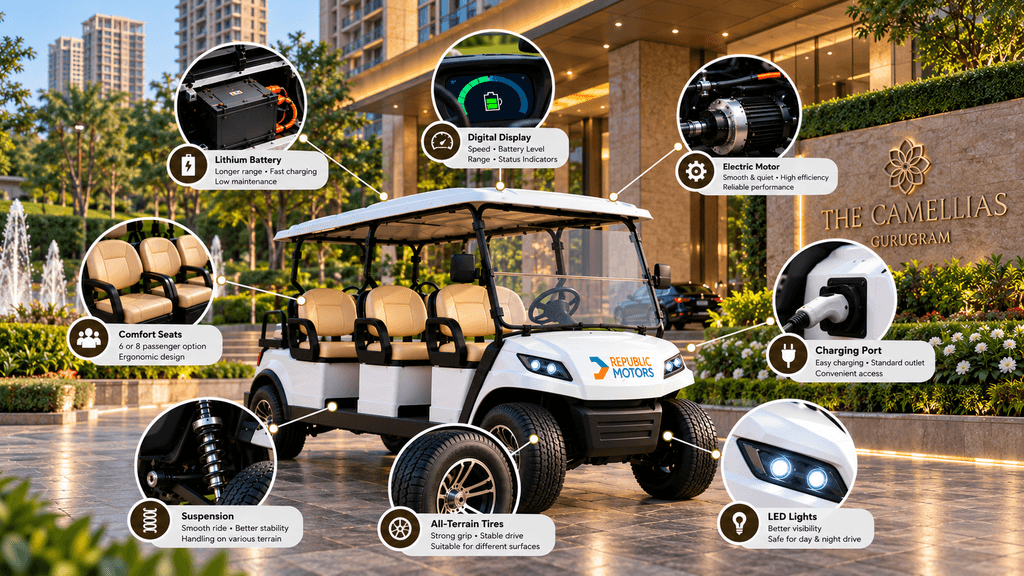
Electric golf cart specifications help buyers determine whether a vehicle can meet their passenger, operational, safety and budget requirements. Comparing technical details before purchasing can help businesses avoid choosing a vehicle that is unsuitable for their routes, working hours or available space.
Republic Motors manufactures electric mobility solutions, including golf carts for commercial and institutional applications. Its RM Series includes 2-seater, 4-seater, 6-seater and 8-seater options. Buyers should compare the latest model-specific specifications and confirm the configuration directly with the manufacturer before placing an order.
For businesses such as hotels, resorts, golf courses, universities, residential communities and industrial facilities, the right golf cart should balance passenger capacity, operating range, charging requirements, manoeuvrability and long-term ownership costs.
1. Battery Type and Battery Capacity
The battery is one of the most important electric golf cart specifications because it affects charging requirements, usable energy and operating costs.
When comparing electric golf cart batteries, check:
- Battery chemistry: Determine whether the model uses lead-acid or lithium-ion batteries.
- Voltage: Confirm the battery pack’s nominal voltage and compatibility with the vehicle.
- Capacity: Review the specified ampere-hour (Ah) rating and, where available, total energy capacity in kilowatt-hours (kWh).
- Charging time: Ask how long a full charge takes with the supplied charger.
- Battery warranty: Check the coverage period, exclusions and replacement terms.
- Replacement cost: Request the expected battery replacement cost and recommended maintenance requirements.
Lead-acid and lithium-ion batteries have different purchase costs, maintenance needs, charging characteristics and service lives. The most suitable option depends on utilisation, charging availability and the buyer’s budget.
Republic Motors’ RM Series 2S product page lists lead-acid and lithium-ion battery options. Buyers should confirm the available battery configuration for the particular model and quotation.
2. Motor Type and Power
Motor specifications help buyers understand how the golf cart is configured for its intended use. However, motor power alone does not determine overall vehicle performance.
Ask the manufacturer about:
- Motor type, such as AC, DC or permanent magnet synchronous motor (PMSM).
- Rated power and peak power.
- Controller specifications and compatibility.
- Performance under the expected passenger or cargo load.
- Suitability for gradients, frequent stops and the intended terrain.
- Availability of service support and replacement components.
For example, a cart operating on a mostly level resort pathway may have different requirements from one used on a large campus with slopes and frequent stops.
Compare the complete vehicle configuration rather than selecting a model based only on its advertised motor power.
3. Maximum Speed
Maximum speed is important when a golf cart will operate around pedestrians, guests, staff and other vehicles.
Confirm the manufacturer’s specified maximum speed and whether it can be configured for your site. A lower operating speed may be appropriate in areas with heavy pedestrian movement, while other applications may have different operational requirements.
Also check whether the intended routes, property rules and applicable regulations permit the vehicle’s use.
Republic Motors’ product listings specify a maximum speed of 25 km/h for several RM Series models. Confirm the current specification for your selected model and its suitability for the intended operating environment.
4. Driving Range per Charge
Range refers to the distance an electric golf cart can travel under specified conditions before its battery needs recharging. It is one of the most important factors for businesses operating carts throughout the day.
When evaluating range, consider:
- Battery chemistry and capacity.
- Passenger or cargo load.
- Route length and terrain.
- Frequency of stops and starts.
- Driving speed and operating conditions.
- Battery condition and charging practices.
Do not assume that an advertised range will always be achieved in daily operations. Actual results may vary with load, terrain, driving style and environmental conditions.
Ask the supplier to clarify whether the stated range is a claimed maximum, an estimated operating range or a result measured under defined test conditions. If your cart must cover a particular distance every shift, discuss that requirement before ordering.
5. Dimensions and Turning Clearance
Vehicle dimensions determine whether a golf cart can operate comfortably within your property.
Check these measurements before buying:
- Overall length.
- Overall width.
- Overall height.
- Ground clearance.
- Turning radius or turning clearance.
- Wheelbase, if provided.
- Parking and charging-space requirements.
Dimensions are especially important for hotels, resorts, residential communities and campuses with narrow paths, sharp corners, covered parking or restricted entrances.
Measure the narrowest part of the intended route, not just the main road. Consider the space needed to turn, board passengers, park and carry out routine maintenance.
Republic Motors publishes model-specific dimensions on its product pages. Verify the latest technical drawing or catalogue with the company before designing parking spaces or finalising access arrangements.
6. Seating Capacity and Passenger Configuration
Seating capacity should match the number of people you regularly need to transport.
Common configurations include:
- 2-seater: May suit individual transfers or smaller passenger requirements.
- 4-seater: May suit routine movement involving small groups.
- 6-seater: May be appropriate for moderate group transportation.
- 8-seater: May suit larger groups and properties with higher passenger demand.
These are general selection guidelines, not fixed rules. The right option depends on your daily passenger volume, route layout and operating requirements.
When comparing seating configurations, confirm whether the stated capacity includes the driver. Ask about seat layout, passenger entry and exit, available luggage space and any restrictions on the intended use.
For a detailed capacity comparison, buyers can also review Republic Motors’ RM Series product range.
7. Load Capacity and Intended Use
Passenger capacity and load capacity are not the same specification. A vehicle’s permitted load determines how much weight it can safely carry according to the manufacturer’s limits.
Ask for the rated load capacity and clarify whether the stated limit includes occupants, luggage, accessories or cargo.
This is particularly important for vehicles used in hotels, resorts, campuses and industrial environments. A cart carrying passengers and luggage may have different requirements from a cargo vehicle transporting supplies.
Never estimate a vehicle’s load limit based only on the number of seats or the apparent strength of its frame. Obtain the manufacturer’s documented limits and follow its operating instructions.
8. Braking System, Tyres and Suspension
Braking and suspension specifications affect how the vehicle responds to the route and operating conditions.
Before buying, check:
- Brake type and servicing requirements.
- Tyre size and availability.
- Suspension configuration.
- Ground clearance.
- Recommended tyre pressure and maintenance.
- Availability of replacement parts.
Consider the surfaces on which the cart will operate. Smooth paved paths, uneven surfaces and sloped routes can place different demands on the vehicle.
Ask the manufacturer to confirm whether the proposed configuration is suitable for the terrain and expected passenger load. Also discuss routine inspection intervals and the availability of service support.
9. Charging Time and Charging Infrastructure
Charging time affects vehicle availability, especially where golf carts are used for multiple trips throughout the day.
Confirm the following before purchase:
- Full-charge time for the selected battery.
- Charger type and electrical requirements.
- Whether a compatible charger is included.
- Recommended charging practices.
- Available charging space and ventilation requirements, where applicable.
- Suitability for your daily operating schedule.
Lead-acid and lithium-ion batteries may have different charging requirements. Do not compare charging times without checking the battery chemistry, capacity, charger and conditions under which the figures were measured.
If the cart is expected to operate for long shifts, ask the supplier how the recommended battery and charging arrangement can support your schedule.
10. Warranty and After-Sales Support
A golf cart is a business asset, so after-sales support can be as important as the initial purchase price.
Review the warranty for the vehicle, battery and other covered components separately. Ask about exclusions, service intervals, response times and the process for reporting faults.
Other useful questions include:
- Are spare parts readily available?
- Where can servicing be carried out?
- What maintenance is required to keep the warranty valid?
- Are technical support and operator guidance available?
- What are the estimated service and replacement-part costs?
Request the warranty terms in writing. Avoid relying solely on general marketing statements when comparing suppliers.
Electric Golf Cart Specifications Comparison Checklist
Use this checklist when evaluating quotations from different manufacturers.
| Specification | What Buyers Should Verify |
| Model | Exact model and configuration |
| Seating capacity | Occupants, including whether the driver is counted |
| Battery | Chemistry, voltage, Ah and kWh where available |
| Motor | Type, rated power and peak power |
| Maximum speed | Specified speed and configuration |
| Range | Claimed distance and test conditions |
| Charging time | Full-charge time and charger requirements |
| Dimensions | Length, width and height |
| Ground clearance | Suitability for the intended route |
| Load capacity | Documented permitted load |
| Brakes and tyres | Specifications and maintenance |
| Warranty | Separate terms for vehicle and battery |
| After-sales support | Service availability and spare parts |
| Total cost | Purchase, charging, maintenance and replacement costs |
The manufacturer should provide the latest technical specifications for the exact model being quoted. If a specification is missing, request written clarification rather than assuming it is the same across all models.
How to Choose the Right Electric Golf Cart for Your Business
The best electric golf cart depends on the way your business will use it.
Hotels and Resorts
Evaluate passenger capacity, guest comfort, luggage requirements, route width and daily travel distance. Quiet operation and reliable service support may also be important for guest-facing transportation.
Golf Courses
Consider passenger requirements, course layout, designated vehicle routes, ground clearance and the intended use of the cart. Confirm any course-specific operating restrictions.
Universities and Campuses
Assess the distance between buildings, peak passenger demand, pedestrian traffic, route gradients and charging arrangements. Ensure that the selected vehicle suits the campus’s internal transportation requirements.
Residential Communities
Consider road width, turning clearance, passenger accessibility, route safety and the expected number of trips per day. The vehicle should suit the community’s layout and operating rules.
Industrial and Commercial Properties
First determine whether the requirement is for passenger transportation, cargo movement or both. A passenger golf cart and a purpose-built utility cart may have different specifications and load limits.
Why Consider Republic Motors?
Republic Motors offers electric golf cart options under its RM Series, including 2-seater, 4-seater, 6-seater and 8-seater configurations. Businesses can review the available models and discuss their operational requirements with the manufacturer. <Cite refs={[“turn322143search0″,”turn322143search4”]} />
Before requesting a quotation, prepare the following information:
- Intended application and operating location.
- Required seating capacity.
- Approximate daily distance.
- Route conditions and gradients.
- Preferred battery type, if any.
- Space and dimension restrictions.
- Required accessories or customisation.
- Expected usage hours and service requirements.
Explore the official Republic Motors product range and request current specifications for the model that matches your requirements.
Choose the Right Golf Cart with Republic Motors
Comparing electric golf cart specifications helps businesses choose a vehicle that fits their passenger requirements, property layout and daily operations. Battery chemistry, motor power, range, dimensions, load capacity, charging time, braking and warranty should all be evaluated before making a purchase.
Republic Motors offers multiple golf cart seating configurations for businesses to consider. Review the current model-specific specifications, assess the intended route and operating schedule, and request a detailed quotation before selecting a vehicle.
The right choice is not simply the cart with the highest range or most powerful motor. It is the vehicle whose verified specifications match your actual operating needs.