
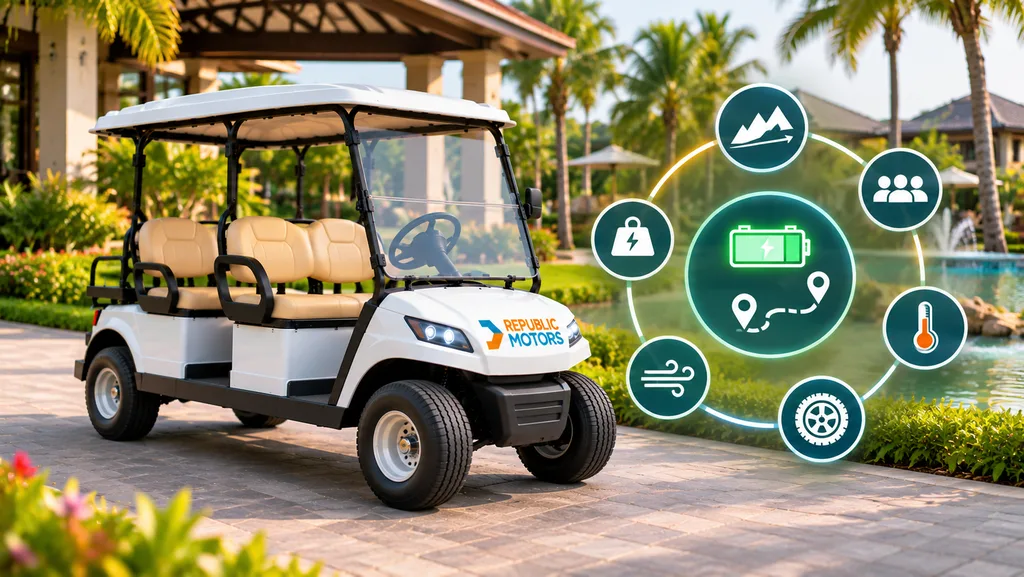
An electric golf cart’s real-world range depends on battery capacity, passenger and cargo load, terrain, driving speed, driving habits, tyre condition, and vehicle maintenance. A cart may cover a different distance in a busy resort or industrial campus than it does during controlled testing. To choose the right vehicle, buyers should evaluate the expected daily route and operating conditions rather than relying on a range figure alone.
Republic Motors has been manufacturing electric vehicles for Indian business requirements since 2013. Its electric golf cart range includes passenger models for golf courses, resorts, campuses, and commercial facilities. The company’s website lists a claimed range of 50–60 km for its RM 4S, RM 6S, and RM 8S models. Actual performance can vary with the vehicle configuration and operating conditions, so buyers should confirm the expected range for their intended use with Republic Motors before making a purchase.
What Is the Real-World Range of an Electric Golf Cart?
Real-world range is the distance an electric golf cart can travel under its actual operating conditions before it needs recharging. It is different from a range figure measured under specific or controlled conditions.
For example, a cart carrying a light load on a level, smooth route may use energy differently from one carrying several passengers across slopes, uneven surfaces, and frequent stops. Battery condition, temperature, speed, and maintenance can also influence performance.
When evaluating range, businesses should consider:
- The expected daily travel distance.
- The number of passengers and amount of cargo carried.
- The type of terrain and surface conditions.
- How frequently the vehicle stops and starts.
- The battery configuration and condition.
- The time available for charging between operating shifts.
A suitable electric golf cart should meet the site’s practical transportation requirements, with an appropriate operating margin for changing conditions.
1. Battery Capacity and Condition
Battery capacity is one of the main factors affecting electric golf cart range. In general, a battery system with greater usable energy can support more driving, provided the vehicle’s power requirements and other conditions remain comparable.
However, battery capacity alone does not determine the distance a cart can travel. Battery chemistry, system configuration, age, temperature, and the condition of the electrical system also matter.
As a battery ages, its usable capacity may decline. A vehicle that previously completed its daily route comfortably may eventually require more frequent charging.
Before buying, ask the manufacturer about the battery configuration, usable capacity, warranty terms, expected operating conditions, and recommended maintenance. Compare vehicles using equivalent specifications rather than battery type alone.
For a related explanation of battery chemistry and selection, read our guide to electric golf cart battery types, if this URL is used for the published battery article.
2. Passenger Load and Cargo Weight
The weight carried by a golf cart affects the energy required to move it. More passengers, golf equipment, luggage, tools, or other cargo can increase the demand on the motor and battery, particularly during acceleration and uphill travel.
The effect depends on the vehicle’s design, the total load, and the route. Therefore, range should be evaluated for the load the cart is expected to carry in everyday use.
For example:
- Golf courses: Consider passengers and golf bags.
- Hotels and resorts: Account for guest numbers and any permitted luggage.
- Campuses: Evaluate typical passenger occupancy throughout the day.
- Factories and warehouses: Include tools, supplies, and cargo where applicable.
Choose a model with a suitable seating and load capacity for the intended application. Never exceed the manufacturer’s specified passenger or payload limits to meet transportation demand.
3. Terrain and Surface Conditions
The route a golf cart travels can make a significant difference to its energy consumption.
Flat, smooth surfaces generally require less energy to navigate than steep slopes or rough, uneven ground. When travelling uphill, the motor needs additional energy to move the combined weight of the vehicle, passengers, and cargo. Loose surfaces, potholes, and other obstacles can also increase rolling resistance.
Consider the following operating environments:
- Golf courses: Grass condition, slopes, and route design influence energy use.
- Resorts: Paved paths, landscaped areas, and ramps may create different demands.
- Industrial facilities: Floor condition, gradients, and cargo movement can affect performance.
- Large campuses: Long routes and repeated elevation changes should be included in range planning.
Before purchasing a cart, assess the actual route and ask the supplier whether the proposed configuration is suitable for those conditions.
4. Driving Speed and Acceleration
Speed and acceleration patterns influence electric golf cart energy consumption. Frequent rapid acceleration can demand more power than smooth, controlled driving. Higher speeds can also increase energy consumption, depending on the vehicle design and operating conditions.
Driving consistently within the manufacturer’s recommended limits can help operators manage energy use more effectively.
For commercial fleets, useful practices include training drivers to accelerate smoothly, avoid unnecessary speeding, and select appropriate routes. These habits should always remain consistent with site rules and safe driving practices.
Do not assume that driving at the lowest possible speed is always the best operating strategy. The appropriate speed depends on the vehicle, route, passenger requirements, and applicable safety rules.
5. Frequent Stops and Starts
A golf cart used on a continuous route may experience different energy demands from one that stops every few minutes.
Vehicles operating at resorts, hospitals, campuses, and event venues may repeatedly accelerate, stop for passengers, wait in queues, and restart. These repeated cycles can affect energy consumption, particularly when the cart is heavily loaded.
When estimating daily range, consider the full operating pattern rather than measuring only the distance travelled. Include waiting periods, passenger pickup points, traffic within the facility, and repeated short journeys.
For fleet planning, it can be useful to record daily distance, operating hours, charging frequency, and typical passenger load. These records help determine whether the selected model meets real operational needs.
6. Tyre Pressure and Vehicle Maintenance
Tyre condition and routine maintenance can affect how efficiently an electric golf cart moves. Incorrect tyre pressure, worn tyres, dragging brakes, or other mechanical problems may increase resistance or energy consumption.
Follow the manufacturer’s maintenance schedule and recommended tyre pressure. Inspect tyres for damage and uneven wear, and arrange professional checks if the vehicle becomes unusually difficult to move or its range drops unexpectedly.
Maintenance should also include appropriate inspection of the battery, electrical connections, brakes, and charging equipment. Any battery-specific maintenance must follow the instructions for that battery type.
Do not attempt repairs on high-current electrical components or damaged batteries without the appropriate training.
7. Temperature and Operating Environment
Ambient temperature can influence battery performance. Very hot or cold conditions may affect the energy available from a battery and its charging behaviour, although the degree of impact depends on the battery chemistry and system design.
In India, electric golf carts may operate in outdoor environments where temperatures and exposure to sunlight vary considerably. Enclosed or shaded operating areas can have different conditions from open routes.
Use and charge the vehicle within the temperature limits specified by the manufacturer. Keep the battery and charging equipment maintained according to the recommended procedure, and seek technical advice if performance changes significantly with weather conditions.
8. Battery Age and Charging Practices
A battery’s condition affects how much usable energy it can provide. Over time, battery capacity may decline, meaning a fully charged cart may travel a shorter distance than it did when new.
Charging practices matter as well. Use a charger approved for the vehicle’s battery system and follow the specified charging procedure. Avoid ignoring charging faults, damaged connectors, or unusual battery behaviour.
If the cart’s range drops noticeably, do not immediately assume that the battery needs replacement. The cause could also involve tyre pressure, excess load, terrain, mechanical resistance, or an electrical fault. A qualified technician can help identify the issue.
For more information, see the related guide on how to charge an electric golf cart safely, if this is the final published URL.
How Can Businesses Estimate Their Required Golf Cart Range?
A practical range assessment begins with the work the vehicle needs to complete each day.
1: Measure the daily route
Estimate the total distance the cart will travel during a normal operating shift, including return journeys and repeated trips.
2: Identify the typical load
Record the usual number of passengers and the weight of any cargo. Confirm that the selected vehicle is rated for the intended load.
3: Assess the terrain
Include slopes, rough surfaces, grass, ramps, and other conditions that may increase energy consumption.
4: Consider stops and operating hours
Frequent passenger pickups, waiting periods, and multiple short trips should be part of the assessment.
5: Confirm the model’s expected performance
Ask the manufacturer to explain the stated range and the conditions under which it applies. Discuss the battery configuration, route, load, and daily usage pattern.
6: Allow for operational variation
Avoid planning every shift around the maximum advertised range. An appropriate operating margin helps accommodate route changes, increased passenger demand, and gradual battery ageing.
For fleet purchases, request a model-specific recommendation based on your actual application.
Choosing the Right Electric Golf Cart for Your Business
The ideal golf cart is not necessarily the one with the highest advertised range. It is the one that meets the required daily distance, seating capacity, payload, route conditions, and operating schedule.
Republic Motors lists its RM 4S four-seater, RM 6S six-seater, and RM 8S eight-seater models with lead-acid or lithium-ion battery options and a listed range of 30–50 km. These are manufacturer-published figures, not a guarantee of the distance achievable under every real-world condition.
Businesses should confirm the current specifications and suitable battery configuration for their chosen model. A four-seater may suit smaller passenger groups, while a six- or eight-seater may be more practical for transporting larger groups, subject to the intended use and vehicle specifications.
Explore the Republic Motors electric golf cart range or contact the team to discuss route conditions, seating requirements, battery options, and expected daily usage.
Conclusion
Electric golf cart range depends on more than battery capacity or an advertised kilometre figure. Passenger load, terrain, driving behaviour, tyre condition, temperature, battery age, and maintenance all influence real-world performance.
For businesses operating golf carts at resorts, golf courses, campuses, hospitals, factories, and other facilities, the best approach is to assess daily routes and loads before choosing a model. Confirm the manufacturer’s current specifications and expected performance for your intended conditions.
Republic Motors offers electric golf cart solutions for commercial applications. Discuss your seating, route, battery, and operating requirements with the team to identify a configuration suitable for your business.