
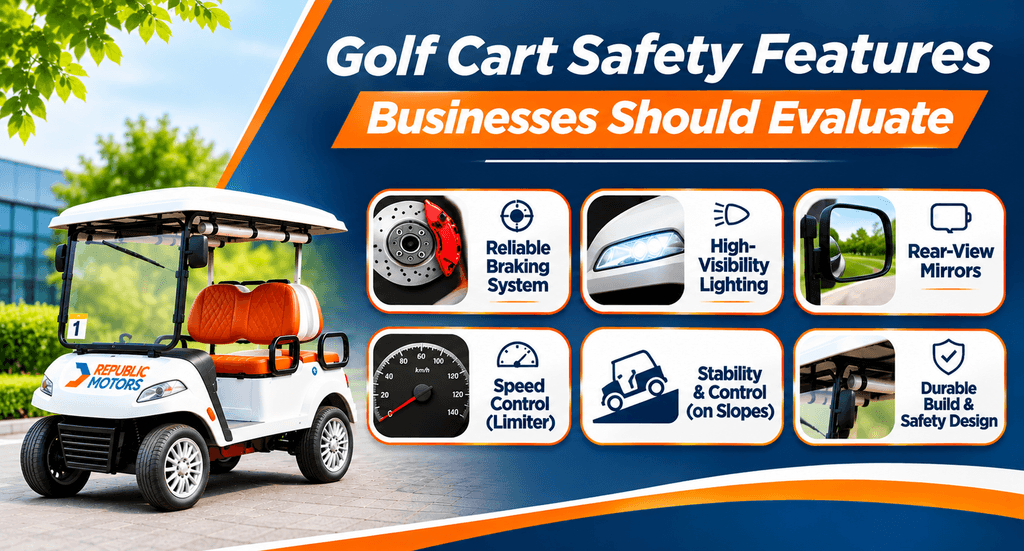
Golf cart safety features are essential when selecting an electric golf cart for commercial use. Before purchasing, businesses should evaluate the braking system, seat belts, headlights, indicators, rear-view mirrors, tyres, steering, speed control, passenger seating, and overall vehicle stability. The right safety configuration depends on the vehicle’s intended application, operating environment, passenger requirements, and manufacturer specifications.
Republic Motors provides electric golf cart solutions for commercial applications such as hotels, resorts, golf courses, campuses, and industrial facilities. When evaluating a golf cart, businesses should look beyond seating capacity and appearance and check whether its safety features suit everyday operations.
Why Are Golf Cart Safety Features Important?
Golf carts are commonly used for short-distance transportation within private properties, commercial premises, and large campuses. They may carry passengers, luggage, equipment, or maintenance supplies throughout the day.
Without suitable safety features and proper operating practices, businesses may face risks related to collisions, sudden stops, poor visibility, passenger falls, and vehicle instability.
Evaluating safety features before purchasing helps businesses:
- Support safer passenger transportation.
- Improve visibility in different lighting conditions.
- Reduce risks associated with improper braking.
- Maintain better vehicle control.
- Protect passengers during normal operation.
- Support consistent fleet inspection and maintenance.
Safety depends on both vehicle design and responsible operation. No single feature can eliminate every operating risk.
12 Important Golf Cart Safety Features Businesses Should Evaluate
1. Reliable Braking System
The braking system is one of the most important safety components of a golf cart. It helps the driver control vehicle speed and bring the vehicle to a stop when required.
Before purchasing, businesses should check:
- Type of braking system installed.
- Brake response and stopping performance.
- Brake pedal condition and operation.
- Parking brake functionality.
- Manufacturer-recommended brake inspection schedule.
The braking system should be appropriate for the vehicle configuration, permitted load, and intended operating environment. Buyers should ask the manufacturer for relevant braking specifications and maintenance recommendations.
2. Seat Belts and Passenger Protection
Seat belts can help restrain occupants during sudden braking or certain unexpected movements, where the vehicle is designed and equipped for their use.
Businesses should check:
- Whether seat belts are provided.
- Whether each designated passenger seating position has the appropriate restraint.
- Whether belts and buckles operate correctly.
- Whether the seating arrangement supports safe passenger movement.
Passenger protection should be evaluated according to the manufacturer’s design and applicable local requirements. Never assume that every golf cart has the same passenger restraint configuration.
3. Headlights and Taillights
Lighting is important when golf carts operate during early mornings, evenings, or in indoor and low-light environments.
Useful lighting components may include:
- Front headlights.
- Rear lights.
- Brake lights.
- Turn indicators.
- Reflectors.
Businesses should verify which lighting features are included in the selected model and whether they meet the requirements of the intended operating location.
4. Turn Indicators and Hazard Lights
Turn indicators communicate the driver’s intention to turn and help other drivers and pedestrians understand the vehicle’s movement.
Hazard lights can be useful when a vehicle is stopped or needs to draw attention to a temporary situation, if the model includes them.
Check that all fitted indicators and warning lights function properly before accepting the vehicle.
5. Rear-View Mirrors
Rear-view mirrors help drivers observe areas behind and beside the golf cart.
They are especially useful in busy locations such as hotels, resorts, campuses, warehouses, and industrial premises where pedestrians and other vehicles may be moving nearby.
Evaluate mirror placement, visibility, adjustability, and stability. The mirrors should allow the driver to check surrounding traffic without unnecessary obstruction.
6. Tyre Quality and Condition
Tyres contribute to traction, steering control, and vehicle stability.
When evaluating a golf cart, check:
- Tyre type and size.
- Manufacturer-recommended tyre pressure.
- Tread condition.
- Signs of damage or uneven wear.
- Suitability for the intended surface.
The correct tyres depend on the vehicle design and operating environment. Businesses should follow the manufacturer’s recommendations rather than fitting tyres based only on appearance.
7. Steering and Vehicle Control
A responsive steering system helps drivers manoeuvre a golf cart safely around pedestrians, pathways, buildings, and other vehicles.
Before purchasing, evaluate steering response, unusual noises, excessive play, and overall control during a supervised inspection.
Also consider the turning space available at the operating site. A vehicle should be suitable for the pathways and routes where it will regularly operate.
8. Speed Control and Acceleration
Golf carts are often used in locations where pedestrians and other vehicles share the same operating space.
Speed control is therefore an important consideration. Businesses should check:
- Available speed-control configuration.
- Accelerator response.
- Smoothness of acceleration.
- Suitability for the operating environment.
- Manufacturer-provided operating limits.
Where different users operate the same fleet, businesses should establish clear speed limits and driver instructions. Any speed-limiting configuration should be approved by the manufacturer.
9. Passenger Seating and Handholds
Passenger seating should provide a suitable arrangement for the intended number of occupants.
Evaluate seat design, available passenger space, entry and exit arrangements, and any fitted handholds or grab rails.
Businesses should also confirm that the vehicle is designed for its advertised seating capacity. Passengers should use only designated seats and should never travel on footboards, cargo platforms, or other unauthorised areas.
10. Vehicle Stability and Load Capacity
Vehicle stability depends on several factors, including design, weight distribution, load, tyres, suspension, and operating conditions.
An overloaded golf cart may become harder to control and may experience reduced braking and handling performance.
Before ordering, businesses should check:
- Maximum permitted payload.
- Passenger capacity.
- Cargo and luggage allowance.
- Manufacturer recommendations for weight distribution.
- Suitability for slopes and uneven surfaces.
Never exceed the manufacturer’s approved load limits. Passengers and cargo should be positioned as instructed.
11. Reverse Warning and Visibility Features
Reversing can create additional risks in crowded commercial environments.
Depending on the model, useful features may include a reverse warning buzzer, mirrors, warning lights, and other visibility aids.
Businesses should check which features are available and establish safe reversing procedures, including checking the area behind the vehicle before moving.
12. Battery and Electrical System Protection
Electric golf carts rely on battery packs, electrical connections, controllers, and charging systems.
Businesses should evaluate the manufacturer’s recommendations for:
- Battery installation and protection.
- Charging equipment compatibility.
- Cable and connector condition.
- Electrical inspection.
- Battery maintenance.
- Safe charging and storage.
For lithium-ion battery configurations, buyers should ask about the battery management system (BMS), protection features, and charging instructions. Do not assume that all battery types or models have identical safety systems.
Golf Cart Safety Checklist Before Purchasing
Use this checklist when comparing different golf cart models.
| Safety feature | What to evaluate |
| Braking system | Brake response and parking brake |
| Seat belts | Availability and proper operation |
| Headlights | Visibility in low-light conditions |
| Indicators | Functional turn signals |
| Rear-view mirrors | Clear rear and side visibility |
| Tyres | Condition, pressure, and suitability |
| Steering | Smooth and controlled operation |
| Speed control | Suitable speed configuration |
| Seating | Designated passenger seats and handholds |
| Load capacity | Approved passenger and cargo payload |
| Reverse warning | Availability of warning features |
| Electrical system | Battery, wiring, and charging protection |
The checklist is a practical buying aid, not a substitute for applicable vehicle safety standards, manufacturer documentation, or a professional inspection.
Safety Requirements for Different Business Applications
Different businesses operate golf carts in different environments. Their safety priorities may therefore vary.
Hotels and Resorts
Hotels and resorts may use golf carts to transport guests, luggage, and staff.
Important considerations include passenger restraints where fitted, comfortable seating, mirrors, lights, braking performance, and suitable speed control. Drivers should also receive instructions for operating around pedestrians.
Golf Courses
Golf courses may have pathways, slopes, grass surfaces, and areas shared by pedestrians and other vehicles.
Businesses should evaluate tyre suitability, braking, steering, visibility, load limits, and manufacturer guidance for operating on the intended terrain.
Hospitals and Healthcare Facilities
Hospitals and large healthcare campuses may require controlled movement of staff, visitors, and supplies.
Quiet operation, controlled speed, clear visibility, suitable passenger arrangements, and predictable braking are important considerations.
Universities and Educational Campuses
Campuses may have frequent pedestrian movement and busy pathways.
Businesses should evaluate lighting, indicators, mirrors, speed control, passenger seating, and driver training before introducing golf carts into daily campus operations.
Factories and Warehouses
Industrial premises may include loading areas, equipment movement, and shared vehicle routes.
Important considerations include braking performance, warning features, visibility, load limits, tyre suitability, and operating procedures around machinery and pedestrians.
Daily Golf Cart Safety Inspection for Businesses
Safety evaluation should continue after purchasing a golf cart. Businesses operating multiple vehicles should introduce a simple daily inspection process.
Before use, the driver or assigned staff member should check:
- Tyres for visible damage and appropriate pressure.
- Brakes and parking brake for proper operation.
- Headlights, indicators, and warning lights.
- Mirrors and visibility.
- Steering response.
- Seat belts and passenger seating, where fitted.
- Battery condition and any visible electrical damage.
- Cargo arrangement and total load.
- Unusual noises, leaks, or visible damage.
Any vehicle with a suspected safety defect should be taken out of service until it has been inspected and cleared by qualified personnel.
Common Golf Cart Safety Mistakes Businesses Should Avoid
Businesses should avoid these common mistakes when purchasing and operating golf carts:
- Choosing a model based only on seating capacity or price.
- Ignoring the manufacturer’s load limits.
- Operating without checking brakes and tyres.
- Allowing passengers to stand or travel in unauthorised positions.
- Ignoring visibility and lighting requirements.
- Driving too fast around pedestrians.
- Reversing without checking the surrounding area.
- Skipping regular maintenance and inspection.
- Allowing untrained people to operate the vehicle.
- Charging batteries without following the manufacturer’s instructions.
A clear operating policy and regular driver training are as important as the vehicle’s installed safety features.
Why Evaluate Safety Features Before Choosing a Republic Motors Golf Cart?
Republic Motors offers electric golf cart solutions for different commercial requirements, including passenger transportation and business applications.
Its product range includes 2-, 4-, 6-, and 8-seater configurations. Businesses should evaluate each model according to the intended application, seating requirements, permitted payload, braking system, lighting, tyres, battery configuration, and available safety equipment.
Before placing an order, discuss the following with the manufacturer:
- Required passenger seating capacity.
- Expected passenger and cargo load.
- Intended operating location and terrain.
- Required lighting and visibility features.
- Braking and speed-control specifications.
- Battery and charging requirements.
- Warranty and maintenance support.
- Availability of any additional safety equipment.
Explore the Republic Motors product range or contact the team through the official contact page to discuss your requirements.
Conclusion
Golf cart safety should be a priority for every business purchasing vehicles for passenger or internal transportation. A suitable braking system, effective visibility features, appropriate seating, tyre condition, speed control, and correct load capacity all contribute to safer operation.
Before selecting an electric golf cart, compare the manufacturer’s specifications with your actual operating requirements. Republic Motors offers different electric golf cart configurations for commercial applications, allowing businesses to discuss suitable models and safety requirements before ordering.