
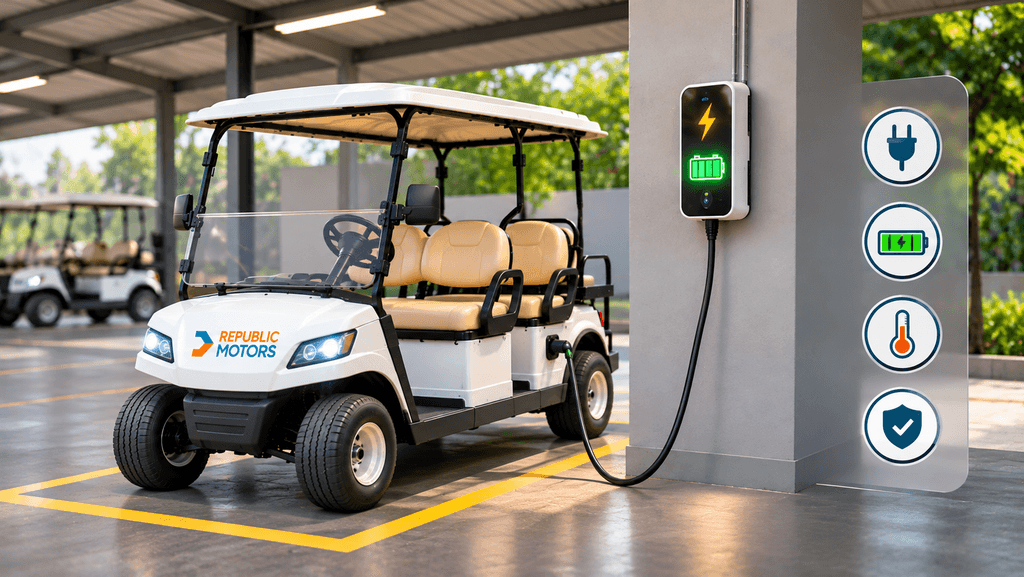
Safe charging of an electric golf cart starts with using the correct charger, following the manufacturer’s instructions, inspecting the battery and charging cables, and keeping the charging area suitable for the battery type. Proper charging practices help reduce electrical hazards, protect battery health, and keep the cart ready for regular operation.
Republic Motors manufactures electric vehicles for business and commercial applications and has operated in the electric vehicle industry since 2013. For businesses using electric golf carts at resorts, hotels, golf courses, campuses, factories, and other facilities, understanding safe charging procedures is an important part of everyday vehicle management.
Whether you operate a two-seater golf cart or a larger passenger model, charging safety should be part of your regular operating routine.
Why Is Safe Electric Golf Cart Charging Important?
Electric golf carts rely on rechargeable battery systems to power their motors and electrical components. Incorrect charging practices can damage batteries, shorten their service life, or create electrical and fire hazards.
The specific risks depend on the battery chemistry, charger, vehicle design, and charging environment. Lead-acid batteries may release hydrogen gas during charging, while lithium-ion batteries require compatible charging equipment and operation within their specified temperature limits.
Safe charging helps you:
- Reduce the risk of electrical shock and short circuits.
- Prevent damage caused by incompatible chargers.
- Maintain battery performance and service life.
- Identify damaged cables or connectors before charging.
- Keep golf carts available for daily business operations.
The correct procedure may vary between models, so always treat the vehicle owner’s manual and battery manufacturer’s instructions as the primary source of guidance.
1. Use the Correct Golf Cart Battery Charger
One of the most important electric golf cart charging safety rules is to use a charger approved for the specific vehicle and battery system.
Chargers are not universally interchangeable. A charger designed for one battery chemistry or voltage configuration may be unsuitable for another.
Before connecting the charger, check:
- Battery chemistry: Confirm whether the cart uses lead-acid, lithium-ion, or another specified battery type.
- System voltage: Make sure the charger is approved for the vehicle’s battery system.
- Charging specifications: Follow the recommended charging profile and current limits.
- Connector compatibility: Use the correct connector without forcing it into place.
- Manufacturer approval: Use the original charger or a compatible replacement explicitly approved by the manufacturer.
Never assume that a charger is suitable simply because its plug fits the cart. If you are unsure about compatibility, contact the vehicle supplier or a qualified technician.
2. Inspect the Golf Cart Before Charging
A quick inspection can help identify problems before electricity is connected.
Check the charging cable, plug, vehicle charging port, and accessible battery connections for visible damage. Look for frayed wires, cracked insulation, loose connectors, corrosion, unusual discoloration, or signs of overheating.
Do not charge the cart if you notice:
- Damaged charging cables or plugs.
- Burn marks or melted connectors.
- Unusual battery swelling, leakage, or a strong abnormal odour.
- Exposed wiring or damaged electrical components.
- Water intrusion or other visible battery damage.
Do not touch leaking battery material or attempt to repair damaged electrical components yourself. Isolate the equipment if it is safe to do so and contact a qualified service professional. If the battery is hot, smoking, hissing, or showing other signs of a thermal event, keep away and follow the site’s emergency procedures.
For business fleets, a simple inspection checklist can help drivers and maintenance teams identify issues consistently.
3. Choose a Suitable Charging Location
The charging location is an important part of electric golf cart safety. Select a designated area that meets the vehicle and battery manufacturer’s requirements.
The charging area should have:
- A stable, dry, and suitable surface.
- Protection from rain, standing water, and excessive moisture.
- Adequate ventilation, particularly for lead-acid battery systems.
- Sufficient clearance around the vehicle and charging equipment.
- Access to an appropriate electrical supply and required protective devices.
- No unnecessary combustible materials near the charging point.
For lead-acid batteries, ventilation is especially important because hydrogen gas may be released during charging. Hydrogen can ignite if it accumulates and encounters a spark or other ignition source.
Avoid charging near open flames, smoking areas, sparks, or hot work. Do not block ventilation openings or cover a charger while it is operating.
For hotels, resorts, industrial facilities, campuses, and golf courses, it is good practice to designate charging areas and restrict access where necessary.
4. Follow the Correct Charging Procedure
Although the exact process varies by golf cart, a safe charging routine generally follows these steps.
1: Park the cart safely
Park on a stable surface in the designated charging area. Apply the parking brake and switch off the vehicle according to the owner’s manual.
Remove the key or disable the vehicle as instructed by the manufacturer.
2: Check the charging equipment
Inspect the charger, power cable, connector, and charging port. Confirm that the equipment is dry and undamaged.
If the charger or connector is wet, damaged, or unusually hot, do not proceed until the issue has been assessed safely.
3: Connect the charger as instructed
Follow the manufacturer’s specified connection sequence. Some vehicles use onboard chargers, while others use external chargers. The correct sequence can differ by model.
Do not force connectors, modify plugs, bypass safety features, or use makeshift adapters.
4: Start charging
Connect the equipment to the specified power supply and confirm that the charger indicates normal operation. If a warning light, error code, unusual sound, or unexpected heat appears, follow the troubleshooting instructions and stop charging if directed.
5: Allow the charging cycle to finish
Use the charger indicators or approved monitoring system to confirm charging status. Avoid repeatedly disconnecting and reconnecting the equipment without a reason.
Do not rely on a universal charging duration because charging time depends on the battery, charger, remaining charge, temperature, and vehicle configuration.
6: Disconnect safely
Once charging is complete, follow the manufacturer’s shutdown and disconnection procedure. Do not pull a plug out by its cable or disconnect equipment in a way that could cause arcing.
Store the cable and charger in the recommended location after use.
5. Understand Charging Safety for Different Battery Types
Battery chemistry affects the precautions required during charging. The following table provides a general comparison; the vehicle and battery manufacturer’s instructions always take priority.
| Safety consideration | Lead-acid battery | Lithium-ion battery |
| Charger compatibility | Must match the specified battery system and charging profile | Must be approved for the specific battery system |
| Ventilation | Important because hydrogen gas may be released during charging | Follow the manufacturer’s ventilation and installation requirements |
| Inspection | Check accessible connections and look for leakage, corrosion, or damage | Watch for damage, swelling, unusual heat, or warning indicators |
| Temperature | Stay within the manufacturer’s specified charging conditions | Follow the battery’s specified charging temperature limits |
| Maintenance | Some types require periodic maintenance; sealed types differ | Follow the manufacturer’s maintenance and monitoring guidance |
| Charging completion | Follow charger indicators and the specified charging procedure | Follow charger and battery management system indicators |
Lead-acid battery precautions
Lead-acid batteries require particular attention to ventilation and ignition sources. Some types may also require electrolyte-level checks under the manufacturer’s maintenance procedure.
Only trained personnel should perform maintenance that involves opening battery compartments or handling battery electrolyte. Never add water to a sealed battery, and do not open a battery unless its design and maintenance instructions specifically permit it.
Lithium-ion battery precautions
Lithium-ion batteries should be charged with compatible equipment and within the specified temperature range. The battery management system may monitor charging conditions and protect the battery, but it does not make an incompatible charger or damaged battery safe.
Never bypass battery protection systems or attempt to override a charging fault. Consult the supplier if the charger reports an error or the battery does not behave as expected.
6. Avoid These Common Golf Cart Charging Mistakes
Even when a cart is used daily, small mistakes can create avoidable risks.
Using an incompatible charger: A connector that fits does not prove that the charger is electrically compatible.
Charging in a poorly ventilated area: This is particularly concerning for lead-acid batteries that may release hydrogen during charging.
Ignoring damaged cables: Frayed insulation, loose plugs, and burned connectors should be assessed before the equipment is used again.
Charging in wet conditions: Water exposure can increase electrical risks. Follow the manufacturer’s requirements for the vehicle, charger, and charging location.
Ignoring warning indicators: Error codes, unusual heat, and repeated charging interruptions should be investigated rather than dismissed.
Using improvised extensions or adapters: Unapproved electrical accessories can create overheating or connection problems. Use only equipment suitable for the installation and approved by a qualified professional.
Assuming every battery charges at the same speed: Charging duration and operating procedures depend on the battery system and charger.
Leaving a faulty charger connected: If the charger or battery shows signs of damage or abnormal operation, follow the manufacturer’s safety procedure rather than continuing the charging cycle.
7. How Long Should You Charge an Electric Golf Cart?
There is no single charging duration that applies to every electric golf cart. The time required depends on battery capacity, the remaining charge, charger output, battery chemistry, temperature, and the manufacturer’s charging settings.
For accurate guidance, check the vehicle manual and charger specifications. If the vehicle has an approved battery monitoring system, use its indicators to understand the charging status.
Avoid estimating charging time from battery type alone. Two carts with the same general battery chemistry may have different capacities and charging requirements.
Businesses operating multiple golf carts should maintain a record of charging interruptions, recurring error codes, and unusual changes in charging time. These observations can help a service technician identify potential problems.
8. Create a Safe Charging Routine for Business Fleets
For commercial operators, charging safety should not depend on individual drivers remembering every precaution. A consistent process makes it easier to manage several vehicles across a site.
Consider introducing these practices:
- Assign a designated charging area.
- Keep approved chargers clearly identified with their compatible vehicles.
- Train operators to inspect cables, connectors, and warning indicators.
- Display simple charging instructions near the charging point.
- Restrict battery repairs to trained and authorised personnel.
- Record charging faults and arrange maintenance when needed.
- Keep the charging area clear and accessible.
- Establish emergency procedures for damaged batteries or electrical faults.
Hotels and resorts may need carts available during different shifts. Golf courses may manage carts used continuously throughout the day. Factories, warehouses, and campuses may operate fleets over longer periods. In each case, charging schedules should be based on actual vehicle usage, the approved charging procedure, and the time required for a safe charging cycle.
9. What Should You Ask Before Buying an Electric Golf Cart?
Charging requirements are worth discussing before purchasing a vehicle, especially when you are buying multiple carts or planning a dedicated charging area.
Manufacturer or supplier:
- Which battery type and voltage configuration does the cart use?
- Which charger is approved for the battery system?
- What are the recommended charging conditions?
- What ventilation and electrical installation requirements apply?
- Are there specific temperature limits for charging?
- How can operators identify a charging fault?
- What maintenance is required for the battery and charging equipment?
- What warranty terms apply to the battery and charger?
- Who should be contacted for servicing or replacement equipment?
- What charging arrangements are recommended for the intended daily usage?
The answers should be specific to the proposed vehicle configuration rather than general statements about all electric golf carts.
Republic Motors offers electric golf cart solutions for commercial requirements. Buyers can discuss intended applications, seating capacity, operating conditions, and charging requirements with the supplier before finalising their vehicle selection.
Explore the Republic Motors product range or contact the team through the official contact page to discuss your requirements.
Conclusion
Safe electric golf cart charging depends on compatible equipment, a suitable charging environment, routine inspections, and the correct operating procedure. Battery chemistry matters, so the precautions for lead-acid and lithium-ion systems should not be treated as interchangeable.
For businesses operating electric golf carts at resorts, golf courses, campuses, factories, or other commercial facilities, a consistent charging routine can support safer daily operations and help identify battery or charger problems early.
Before charging or purchasing a cart, consult the manufacturer’s instructions and confirm the requirements for the exact vehicle and battery configuration.
One Response