
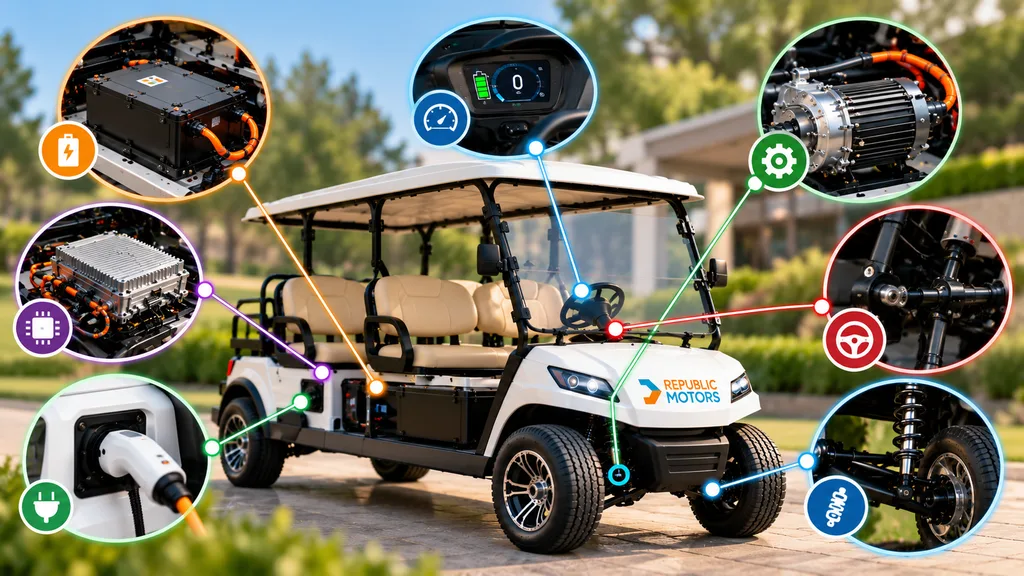
electric golf cart works by converting electrical energy stored in a rechargeable battery into mechanical energy that turns the wheels. When the driver presses the accelerator, the controller regulates power from the battery to the electric motor. The motor then drives the wheels, allowing the cart to move forward or backward. Other components, including the braking system, direction selector, charger and steering system, help the vehicle operate safely and efficiently.
Republic Motors provides electric golf cart and commercial EV solutions for business environments such as resorts, golf courses, campuses and other facilities. Understanding how these vehicles work helps buyers make informed decisions about their power systems, maintenance requirements and suitability for daily operations.
What Are the Main Components of an Electric Golf Cart?
An electric golf cart consists of several interconnected components that work together to deliver movement, control and safe operation. The exact configuration varies by model.
| Component | Main function |
| Battery pack | Stores electrical energy |
| Electric motor | Converts electrical energy into rotational movement |
| Motor controller | Regulates power delivered to the motor |
| Accelerator pedal | Communicates the driver’s speed demand |
| Direction selector | Selects forward or reverse operation |
| Transmission or drive system | Transfers motor torque to the wheels |
| Braking system | Slows down or stops the vehicle |
| Onboard charger or charging connection | Allows the battery to be recharged |
| Steering system | Controls the direction of travel |
| Chassis and suspension | Support the vehicle and help manage road conditions |
These components may differ according to the golf cart’s design, seating capacity, battery technology and intended application.
Electric Golf Cart Work Step by Step?
An electric golf cart follows a straightforward process: stored electrical energy is converted into movement, and the driver controls how that movement is delivered.
1. Battery Stores Electrical Energy
The battery pack is the primary energy source of an electric golf cart. It stores electricity that powers the motor and other electrical systems.
Golf carts may use lead-acid or lithium-ion batteries, depending on the vehicle’s configuration. Each technology has different characteristics in terms of weight, charging behaviour, maintenance, usable capacity and lifecycle cost.
Battery capacity, vehicle load, terrain, driving habits and accessory usage can all affect how long the cart operates between charges.
2. Accelerator Sends a Speed Demand
When the driver presses the accelerator pedal, a sensor or switch communicates the requested acceleration to the vehicle’s control system.
The pedal does not usually supply power to the motor directly. Instead, it provides an input that allows the controller to determine how much electrical power should be delivered, subject to the system’s design and operating limits.
This gives the driver control over acceleration and vehicle speed.
3. Controller Regulates Electrical Power
The motor controller is a key part of the electric golf cart’s powertrain. It manages the electrical energy supplied to the motor in response to the accelerator input and the system’s operating conditions.
Depending on the vehicle design, the controller may also work with safety interlocks, direction selection and other electronic systems.
A properly matched battery, controller and motor are important for smooth operation. Their specifications should be considered together rather than evaluated as separate components.
4. Electric Motor Produces Movement
The electric motor converts electrical energy into rotational mechanical energy. This rotation produces torque, which is used to move the vehicle.
Different electric motor designs may be used in golf carts. The motor type and its characteristics influence how the vehicle delivers power, responds to acceleration and performs under load.
For commercial buyers, motor selection should reflect the intended application. A cart used for short trips around a resort may face different operating conditions from one transporting people or materials across a large industrial facility.
5. Drive System Transfers Torque to the Wheels
The motor’s rotational output is transferred through the vehicle’s drive system to the wheels. Depending on the design, this may involve a differential, reduction gearing or other drivetrain components.
The drive system helps translate motor rotation into usable wheel movement. Its configuration affects how the cart delivers torque and moves under different load and terrain conditions.
When evaluating an electric golf cart, buyers should consider not only the motor but also the complete powertrain and the vehicle’s intended operating environment.
6. Direction Selector Controls Forward and Reverse
The direction selector allows the driver to choose forward or reverse travel. The controller and associated electrical systems manage the motor’s operation according to the selected direction.
The driver should follow the manufacturer’s operating instructions and bring the vehicle to a complete stop before changing direction unless the vehicle’s manual specifies otherwise.
7. Braking System Slows or Stops the Cart
The braking system allows the driver to reduce speed and bring the vehicle to a stop. Electric golf carts may use mechanical or hydraulic service brakes, parking brakes and, on some models, regenerative braking.
Regenerative braking, where supported, uses the motor as a generator during deceleration to convert some of the vehicle’s kinetic energy back into electrical energy. The amount of energy recovered depends on the system design and operating conditions.
Regenerative braking does not replace the need for a properly maintained service braking system. Buyers should confirm the braking configuration and safety features of the specific model.
How Is an Electric Golf Cart Battery Charged?
An electric golf cart is recharged by connecting it to a compatible charger and an appropriate electrical supply, following the manufacturer’s instructions.
The charger manages the charging process according to the battery chemistry and system requirements. Charging time depends on factors such as battery capacity, the remaining charge, charger output, battery condition and charging-system design.
For business operations, charging arrangements should be planned around daily usage. Consider:
- The availability of suitable charging points.
- The time available between operating shifts.
- The battery’s usable capacity and charging requirements.
- The electrical supply and installation requirements.
- The manufacturer’s guidance on charging and storage.
Use only a compatible charger and follow the specified charging procedure. Avoid assuming that all golf cart batteries have the same charging time or requirements.
What Affects Electric Golf Cart Range and Performance?
The operating range of an electric golf cart is not determined by battery capacity alone. Several factors influence how much energy the vehicle consumes during use.
Battery capacity and condition
Battery capacity affects the amount of energy available for operation. Battery age, condition and temperature can also influence usable performance.
Passenger and cargo load
Carrying more passengers or cargo generally requires more energy to move the vehicle. Buyers should check the rated passenger and load limits for their chosen model.
Terrain and gradients
Flat, smooth surfaces usually place different demands on a cart than steep gradients, uneven paths or rough ground. Frequent climbing can increase energy consumption.
Driving habits
Frequent acceleration, sudden stops and repeated short trips can affect energy consumption. Operating the vehicle smoothly may help improve efficiency.
Tyres and maintenance
Incorrect tyre pressure, worn components, poor wheel alignment or drivetrain issues may affect rolling resistance and energy use. Regular maintenance helps the vehicle perform as intended.
Accessories and operating conditions
Lighting, additional electrical accessories, temperature and the length of operating periods can also affect energy consumption.
For this reason, businesses should assess range against their actual routes, passenger loads and daily duty cycle rather than relying on a single estimated range figure.
Electric Golf Cart Maintenance: What Should You Check?
Electric golf carts generally have fewer engine-related maintenance requirements than conventional petrol-powered vehicles, but they still need regular inspection and servicing.
A practical maintenance routine should include:
- Battery: Inspect and maintain the battery according to its chemistry and the manufacturer’s guidance.
- Charging equipment: Check charging cables, connectors and visible signs of damage.
- Tyres: Maintain the recommended tyre pressure and inspect tread condition.
- Brakes: Check brake operation and arrange servicing when necessary.
- Steering and suspension: Inspect for looseness, unusual noise or changes in handling.
- Electrical connections: Have damaged wiring or abnormal electrical behaviour checked by a qualified technician.
- Drive system: Follow the prescribed inspection and lubrication schedule, where applicable.
- Cleaning and storage: Keep the vehicle clean and follow the recommended storage and parking procedures.
Maintenance intervals and procedures vary by model. Always follow the manufacturer’s service schedule and safety instructions.
Where Are Electric Golf Carts Commonly Used?
Electric golf carts can support short-distance transportation in locations where their capacity, speed, operating range and vehicle configuration meet the site’s requirements.
Common applications include:
- Golf courses: Moving golfers, staff and equipment around the course.
- Hotels and resorts: Guest transportation within large properties.
- Educational campuses: Moving authorised passengers across campus areas.
- Industrial facilities: Transporting personnel and selected materials over suitable internal routes.
- Residential townships: Supporting internal mobility where permitted.
- Events and large venues: Assisting with staff movement and authorised transportation.
For each application, the buyer should assess route conditions, passenger requirements, load limits, charging access and applicable site safety rules.
Republic Motors offers an electric golf cart range for business and institutional requirements. Buyers can explore the available models through the Republic Motors product range and review the RM Series 6S and RM Series 8S pages for model-specific information.
How to Choose the Right Electric Golf Cart for Your Business
Understanding the working principle is only the first step. Before selecting a vehicle, consider the following questions:
- How many passengers or how much cargo must it carry?
- What distance will it travel during a typical operating day?
- Will it operate mainly on flat paths, slopes or uneven surfaces?
- Which battery technology and charging arrangement suit the operation?
- What safety features and braking system does the model provide?
- Is after-sales support available for the intended operating location?
- What are the expected maintenance requirements and total ownership costs?
Request confirmed specifications and a quotation for the exact model and configuration being considered. For customised requirements or commercial use cases, contact Republic Motors to discuss available options.
Conclusion
An electric golf cart works through the coordinated operation of its battery, controller, motor, drive system and supporting components. The battery stores electrical energy, the controller manages its delivery, and the motor converts it into the movement that drives the wheels. Charging, braking and routine maintenance are equally important to dependable operation.
For businesses evaluating electric golf carts, understanding these components makes it easier to compare models and identify a vehicle suited to their daily requirements. Republic Motors provides electric golf cart solutions for a range of commercial applications. Review the available models and confirm their specifications before making a purchasing decision.