
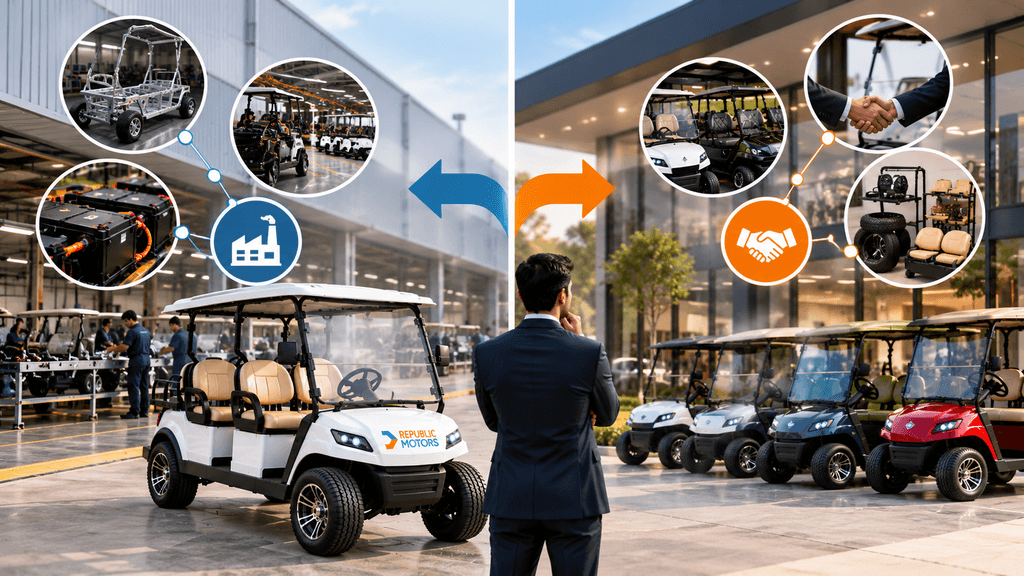
Businesses planning to buy an electric golf cart generally have two options: contact a manufacturer directly or purchase through a dealer. The right choice depends on the number of vehicles required, customization needs, delivery location, budget, warranty terms, and the level of after-sales support available.
Republic Motors, an electric mobility company established in 2013, offers golf carts and other electric vehicle solutions for different business requirements. Buyers can explore its product range and evaluate which available models suit their intended application.
For hotels, resorts, golf courses, universities, factories, and residential communities, choosing the right supplier is about more than the initial purchase price. Product suitability, technical information, spare parts, service arrangements, and long-term operating costs also matter.
What Is the Difference Between a Golf Cart Manufacturer and a Dealer?
A golf cart manufacturer produces or assembles vehicles and may provide product specifications, configuration information, and technical support, depending on its business model.
A golf cart dealer purchases or distributes vehicles from one or more manufacturers and sells them to customers. Dealers may also provide local delivery, product demonstrations, servicing and maintenance, depending on their arrangements.
The exact responsibilities can vary. Some manufacturers sell directly to customers and also work with dealers. Some dealers maintain service facilities, while others focus mainly on sales.
Therefore, buyers should compare the actual services offered by each supplier rather than assuming that every manufacturer or dealer operates in the same way.
1. Buying Directly from a Golf Cart Manufacturer
Contacting a manufacturer can be useful when a business needs detailed product information, multiple vehicles, or a configuration suited to a specific application.
Advantages of contacting a manufacturer
Direct product information: Buyers can ask about available models, technical specifications, seating configurations, battery options, and intended applications.
Customization discussions: If customization is supported, a direct discussion may help buyers understand which body styles, accessories, seating arrangements, or utility configurations are feasible.
Bulk purchasing discussions: Businesses planning to purchase several carts can discuss fleet requirements, consistent specifications, and delivery scheduling.
Technical clarification: A manufacturer may be able to provide more detailed information about the vehicle platform, components, operating requirements, and maintenance recommendations.
What should buyers confirm?
Direct contact does not automatically guarantee a lower price, faster delivery, or better service. Buyers should confirm whether the company sells directly, which customization options are available, what the warranty covers, and how service requests will be handled.
For example, a resort purchasing several passenger carts may benefit from discussing fleet requirements and specifications directly with the manufacturer. However, if the manufacturer does not provide local service, the buyer may still need an authorized service partner.
2. Buying Through a Golf Cart Dealer
A dealer can be a practical option for businesses that prefer local assistance or want to compare products from different suppliers.
Advantages of buying through a dealer
Local assistance: A dealer near the buyer may offer easier communication, product demonstrations, or support with delivery arrangements.
Product comparisons: Dealers representing multiple brands may help buyers compare models, depending on their current portfolio.
Service convenience: Dealers with qualified technicians and appropriate parts availability may provide convenient local maintenance support.
Regional knowledge: A dealer familiar with local operating conditions may help buyers identify practical considerations related to routes, site access, and service availability.
What should buyers confirm?
Not every dealer represents multiple brands or maintains a service facility. Buyers should verify the dealer’s authorization, the original manufacturer, warranty arrangements, parts availability, and who will handle technical issues.
Also ask whether the quoted price includes delivery, accessories, applicable taxes, and any dealer-specific charges.
A local dealer may be the better option when convenient regional support is a priority, provided the dealer can demonstrate the necessary service capabilities.
3. Manufacturer vs Dealer: A Practical Comparison
| Buying factor | Manufacturer | Dealer |
| Product information | May provide direct technical and model information | Depends on training and manufacturer support |
| Customization | Can discuss factory-supported options | Depends on dealer authority and available configurations |
| Product selection | Usually focused on its own product range | May offer one or multiple brands |
| Pricing | Direct quotation may be available | Dealer quotation may include local services or other costs |
| Bulk orders | Can discuss production and fleet requirements | May coordinate orders through its supply network |
| Local support | Depends on service network | May offer convenient regional assistance |
| Warranty | Usually defines or administers manufacturer warranty terms | May help coordinate warranty claims |
| Spare parts | Confirm parts supply and distribution arrangements | Confirm local stock and replenishment times |
| Delivery | Depends on production and dispatch schedule | May offer local delivery or stock availability |
| Best fit | Buyers needing detailed product discussions or fleet planning | Buyers prioritizing local assistance or dealer-led comparisons |
4. Which Option Is Better for Bulk Golf Cart Purchases?
Businesses purchasing multiple electric golf carts should evaluate the entire procurement process.
For a large resort, golf course, university, or industrial facility, important questions include:
- Can the supplier provide the required number of vehicles?
- Can all vehicles meet the same specifications?
- What is the estimated delivery schedule?
- Are phased deliveries possible?
- What documentation is supplied with each vehicle?
- How will maintenance and warranty requests be managed?
- Are replacement parts available for the selected models?
A manufacturer may be suitable for discussing fleet configurations and production planning. A capable dealer may be equally useful if it has sufficient supply arrangements and local service resources.
Request a written quotation that separates vehicle costs, accessories, delivery, taxes, and any other charges. For bulk orders, also confirm payment milestones, delivery commitments, and the process for handling damaged or non-conforming goods.
5. Who Should You Contact for Custom Electric Golf Carts?
If your business needs a specific vehicle configuration, start by identifying the requirements that cannot be compromised.
These may include seating capacity, battery type, expected daily range, cargo needs, branding, passenger comfort, or compatibility with your site.
A manufacturer can be a useful starting point for understanding which configurations are technically available. A dealer may also be able to arrange suitable options if it is authorized to offer them.
Before confirming a custom order, ask:
- Is the requested configuration available for this model?
- Will modifications affect the warranty?
- Are the requested accessories included in the quotation?
- Will the final dimensions or load capacity change?
- What is the confirmed delivery timeline?
- Can the supplier provide the agreed specifications in writing?
Do not assume that every requested modification is possible. Structural changes, additional seating, and utility attachments should be evaluated for compatibility and safe operation.
6. Compare Warranty and After-Sales Service Before Buying
Warranty and service support are important whether you purchase directly or through a dealer.
An attractive purchase price may not represent the best value if replacement parts are difficult to obtain or service arrangements are unclear.
Before ordering, ask for written details of:
- Vehicle and battery warranty coverage
- Warranty duration, exclusions, and claim procedures
- Scheduled maintenance requirements
- Availability of replacement parts
- Service coverage at your operating location
- Expected response and repair procedures
- Battery replacement and disposal guidance, where applicable
Also establish who will be your primary contact if a problem occurs: the manufacturer, dealer, or an authorized service partner.
For businesses relying on carts every day, a clear maintenance and support plan can help reduce avoidable operational disruption.
7. How to Evaluate the Total Cost of Ownership
The initial purchase price is only one part of the cost of owning an electric golf cart.
A useful comparison includes the following:
Purchase cost: Vehicle price, taxes, delivery, and required accessories.
Charging and electricity: Estimated charging requirements based on the operating schedule and local electricity tariff.
Maintenance: Routine inspections, servicing, tyres, brakes, and other wear-related components.
Battery costs: Warranty coverage, expected replacement requirements, and replacement availability.
Downtime: The potential impact of a vehicle being unavailable during repairs.
Support costs: Travel, service visits, logistics, and other applicable charges.
Ask both manufacturers and dealers for quotations based on the same vehicle requirements. This makes it easier to compare like-for-like costs instead of choosing solely on the lowest headline price.
Actual ownership costs will depend on usage, local conditions, maintenance practices, and the terms offered by the supplier.
8. Why Consider Republic Motors?
Republic Motors operates in the electric mobility sector and offers golf carts for different passenger capacities, alongside cargo cart solutions.
Its listed golf cart range includes RM Series 2S, RM Series 4S, RM Series 6S, and RM Series 8S models. Businesses can review the available products and discuss their requirements before deciding which configuration may be suitable.
For organizations evaluating golf carts for hotels, resorts, campuses, golf courses, or other commercial settings, the selection process should begin with the intended use, passenger or cargo requirements, site conditions, and service expectations.
You can explore the Republic Motors product range and contact the company through its official contact page to enquire about available models, specifications, and quotations.
Confirm current product availability, direct purchasing arrangements, customization options, and after-sales support with the company before making a procurement decision.
Choose the Right Golf Cart
Choosing between a golf cart manufacturer and a dealer depends on what matters most to your business. Direct manufacturer contact may be useful for technical discussions, supported customization, and fleet planning, while a capable dealer may offer local assistance, demonstrations, and service convenience.
The best approach is to compare both options using the same requirements and evaluate the complete package: vehicle suitability, final price, delivery, warranty, spare parts, and after-sales support.
For businesses exploring electric golf carts in India, Republic Motors is one option to evaluate alongside other suitable suppliers. Review the available models, clarify your operational requirements, and obtain a detailed quotation before making the final decision.