
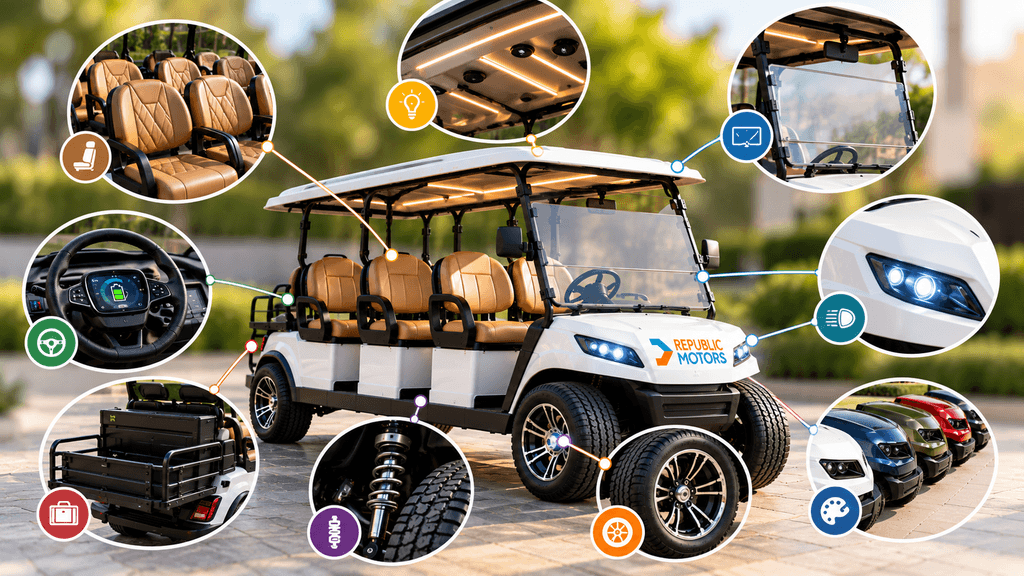
Custom electric golf carts allow businesses to choose a vehicle configuration that better suits their operational requirements, passenger capacity, site layout, and daily usage. Before placing an order, buyers should discuss seating arrangements, body design, battery options, range requirements, storage, safety features, and after-sales support with the manufacturer.
Republic Motors, an electric mobility manufacturer established in 2013, offers golf carts and other electric vehicle solutions for different mobility requirements. Businesses evaluating a customized vehicle can explore the available product range and discuss their specific application with the company.
The right customization is not simply about appearance. It should help the vehicle perform its intended job efficiently while meeting the buyer’s budget, site conditions, and maintenance requirements.
What Are Custom Electric Golf Carts?
Custom electric golf carts are electric vehicles configured or adapted to meet particular user requirements. Depending on the manufacturer’s capabilities and the selected platform, customization may involve seating arrangements, colours, body styling, storage, accessories or application-specific features.
A resort may need a passenger cart for guest transportation, while a factory may require a utility configuration for moving tools and supplies. A university campus may prioritize passenger capacity, easy entry and exit, and convenient movement between buildings.
Customization can help businesses select a more suitable solution than choosing a vehicle based only on its appearance or seating capacity.
However, not every feature is available on every model. Buyers should confirm the feasibility, additional cost, delivery timeline and warranty implications of each requested modification before ordering.
1. Choose the Right Seating Capacity
Seating capacity is one of the first decisions to discuss when ordering a custom electric golf cart.
The appropriate configuration depends on how many people travel together, how frequently the vehicle operates and how much space is available at the site.
2-seater golf carts
A 2-seater golf cart may suit short-distance transportation for two people, golf course operations or individual mobility requirements within a large property.
4-seater golf carts
A 4-seater model can be suitable for smaller guest groups, resort transportation, residential communities and selected campus applications.
6-seater and 8-seater golf carts
Higher-capacity configurations may be useful for transporting guests, visitors or staff across larger properties. Buyers should evaluate passenger comfort, route width, turning space and the frequency of trips before choosing a larger vehicle.
Republic Motors lists 2-, 4-, 6- and 8-seater golf cart models in its product range. Buyers should confirm the current configuration and available customization options for their chosen model.
The important question is not simply how many seats can fit into the vehicle. It is whether the selected configuration will work safely and comfortably within the intended operating environment.
2. Discuss Body Design, Colour and Branding
A customized golf cart can also support a business’s visual identity.
Hotels, resorts, golf courses and premium residential properties may want a vehicle that complements their surroundings or brand guidelines. Before ordering, discuss the following options with the manufacturer:
- Available body colours and finishes
- Seat colours and upholstery choices
- Logo placement and branding requirements
- Exterior styling and trim
- Weather protection or enclosure options, where available
- Suitability of materials for the operating environment
For example, a resort may prefer a finish that complements its property, while a corporate campus may want consistent branding across its internal transportation fleet.
Ask for confirmation of available colours, sample images or a proposed design before approving production. Also clarify whether branding and special finishes affect the quotation or delivery schedule.
3. Select the Appropriate Battery Configuration
Battery selection affects charging arrangements, operating costs and vehicle availability. Buyers should compare available battery options against their daily usage rather than selecting a battery solely on its initial purchase price.
Discuss these points with the manufacturer:
- Available battery technologies
- Battery voltage and capacity
- Expected operating range under specified conditions
- Charging time and charger compatibility
- Battery warranty and replacement terms
- Availability of replacement batteries and service support
Lead-acid and lithium-ion batteries have different purchase costs, maintenance requirements and charging characteristics. The better choice depends on the selected vehicle, operating schedule, budget and available charging facilities.
For example, a hotel operating carts throughout the day may need to plan charging around guest transportation schedules. A facility using its cart for occasional short trips may have different priorities.
Ask the manufacturer to clarify how its range estimate is measured. Passenger load, terrain, driving behaviour, battery condition and operating conditions can affect actual range. Do not treat a quoted maximum range as a guaranteed result in every situation.
4. Define Your Daily Operating Requirements
Before requesting a custom electric golf cart quotation, explain where and how the vehicle will operate.
Different environments create different requirements.
Hotels and resorts
Guest transportation may require comfortable seating, easy entry and exit, luggage space and a suitable appearance. Buyers should also consider the routes between reception areas, accommodation blocks, restaurants and parking areas.
Golf courses
Golf course operators may prioritize passenger comfort, manoeuvrability, course layout and any golf equipment storage required for their operations.
Universities and campuses
Large campuses may need transportation between academic buildings, hostels, parking areas and administrative facilities. Route length, passenger demand and charging schedules are important considerations.
Factories and warehouses
Industrial facilities may require utility-oriented configurations for moving tools, supplies or lightweight materials. Buyers should specify the type of load, loading method, operating surface and required storage arrangement.
Residential communities
Gated communities and townships may use golf carts for internal transportation, visitor movement or operational support. Narrow lanes, ramps, pedestrian traffic and parking areas should be considered during selection.
Clearly describing the intended use helps the manufacturer recommend a suitable configuration rather than an unnecessary collection of features.
5. Evaluate Storage and Utility Features
Some businesses need a vehicle primarily for passengers, while others require a combination of passenger transportation and material movement.
Depending on the platform and available configurations, buyers may ask about:
- Rear storage or cargo compartments
- Utility trays or cargo platforms
- Tool and equipment storage
- Enclosed storage arrangements
- Housekeeping or facility-support configurations
- Accessory mounting points
For example, a resort’s housekeeping team may require space for supplies, while a factory maintenance team may need a practical way to transport tools between work areas.
Republic Motors also lists cargo cart solutions in its product range. Businesses with material-handling requirements should compare these utility-oriented vehicles with passenger golf carts before deciding whether a customized passenger model is appropriate.
Always specify the expected load and ask the manufacturer to confirm the rated payload, load distribution requirements and suitability of the proposed configuration. Additional storage should not compromise vehicle stability, passenger space or safe operation.
6. Compare Safety and Comfort Features
Customization should never prioritize appearance over safe operation.
Before placing an order, discuss which safety and comfort features are available for the selected model. Depending on the vehicle and configuration, these may include:
- Seat belts, where provided or required
- Headlights, indicators and rear lights
- Mirrors and horn
- Braking system
- Tyres and suspension
- Passenger handholds and entry arrangements
- Weather protection, where available
- Visibility and ease of access
The required configuration will depend on the vehicle, operating environment and applicable rules. Ask the manufacturer to explain which features are standard, which are optional and which are necessary for the intended application.
Also consider driver visibility, pedestrian movement, slopes, uneven surfaces and the width of internal routes. A vehicle should be selected for the actual conditions in which it will operate.
7. Confirm Dimensions and Site Compatibility
A custom golf cart must fit the operating site, not just the buyer’s preferred design.
Before finalizing the order, check:
- Available parking and charging space
- Width of access routes
- Turning areas and corners
- Doorway or covered passage clearances
- Ramp gradients and surface conditions
- Space for passenger entry and exit
- Storage and maintenance access
Ask the manufacturer for the exact dimensions of the proposed configuration, including any changes caused by accessories or body modifications.
For multi-seater vehicles, confirm that the additional seating arrangement will work with the available routes and parking areas. If necessary, measure the site and share a simple layout or photographs with the supplier.
This step can help prevent operational difficulties after delivery.
8. Discuss Customization Costs and Delivery Timelines
Custom electric golf cart pricing depends on the selected vehicle and the requested configuration. A quotation may change according to seating, battery choice, body modifications, accessories, branding and other requirements.
Request an itemized quotation that clearly identifies:
- Base vehicle price
- Included standard features
- Optional accessories and customization charges
- Battery and charger specifications
- Applicable taxes and delivery costs
- Warranty coverage
- Estimated production and delivery timeline
- Payment terms and quotation validity
Ask whether the proposed modifications affect the manufacturer’s standard warranty or service arrangements.
It is also helpful to request written confirmation of the agreed specifications. A clear order document reduces the risk of misunderstandings between the buyer and manufacturer.
9. Check Warranty, Maintenance and After-Sales Support
A golf cart is an operational asset, so the purchase decision should include support after delivery.
Before ordering, ask about the warranty on the vehicle, battery and major components. Confirm the duration, coverage conditions, exclusions and process for making a claim.
You should also discuss:
- Availability of replacement parts
- Routine maintenance requirements
- Service support for your location
- Battery inspection and replacement procedures
- Troubleshooting and technical assistance
- Recommended maintenance intervals
For organizations operating multiple carts, maintenance planning is especially important. Unexpected downtime can affect guest transportation, campus mobility or internal logistics.
Choose a supplier that can explain the service process clearly and provide written warranty and maintenance information.
10. Before Ordering a Custom Electric Golf Cart
Before confirming your purchase, use this checklist:
- Which standard models can meet our requirements?
- Which customization options are available for the selected model?
- What seating configurations can be supplied?
- Which battery options and chargers are compatible?
- What range should we expect under our operating conditions?
- What are the vehicle’s dimensions and rated load capacity?
- Which safety features are included?
- Can we add branding, storage or application-specific accessories?
- Will customization affect the warranty?
- What is the final price, including applicable taxes and delivery?
- What is the estimated delivery timeline?
- What after-sales and spare-parts support is available?
Share your intended use, daily operating hours, expected passenger or cargo load and site conditions with the manufacturer. These details make it easier to assess the available options and obtain a relevant quotation.
Why Consider Republic Motors for Your Requirements?
Republic Motors has been operating in the electric mobility sector since 2013 and offers golf carts alongside other electric vehicle solutions. Its listed golf cart range includes RM Series 2S, RM Series 4S, RM Series 6S and RM Series 8S models, as well as cargo cart options.
Businesses looking for custom electric golf carts can review the available range and contact Republic Motors to discuss their application, preferred configuration and requirements. The availability of specific modifications should be confirmed directly before placing an order.
You can explore the Republic Motors product range or contact the team through the official contact page to discuss your requirements.
Conclusion
Choosing custom electric golf carts starts with understanding the job the vehicle must perform. Seating capacity, battery configuration, operating range, body design, storage, safety, site dimensions and after-sales support should all be considered before ordering.
A clear specification and written quotation help businesses compare options and reduce the risk of selecting an unsuitable configuration. By discussing these requirements with an experienced manufacturer such as Republic Motors, buyers can evaluate the available electric golf cart solutions against their actual operational needs.
One Response