
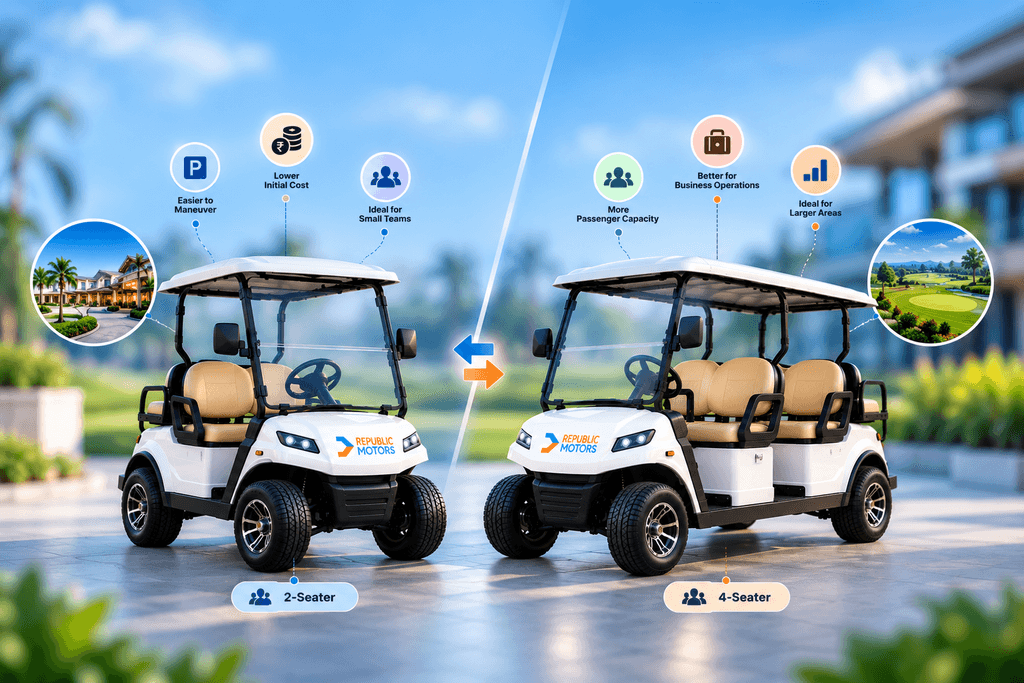
A 2-seater golf cart is ideal for compact transportation and low passenger demand, while a 4-seater golf cart is generally better for businesses that regularly transport small groups. The right choice depends on passenger capacity, available space, daily operating distance, budget, and the intended application.
Republic Motors, an Indian electric vehicle manufacturer operating since 2013, offers electric golf cart configurations for commercial and institutional requirements. Its RM Series includes 2-seater and 4-seater options, allowing businesses to compare vehicle size and passenger capacity before choosing a suitable model.
For hotels, resorts, golf courses, universities, residential communities, and commercial properties, comparing these configurations helps identify a golf cart that meets daily transportation needs without paying for unnecessary capacity.
1. What Is the Difference Between a 2-Seater and a 4-Seater Golf Cart?
The main difference is passenger capacity, although dimensions, seating layout, and available features can also vary by model.
A 2-seater electric golf cart is designed for compact transportation, typically accommodating a driver and one additional passenger. It can be suitable for golf course movement, short-distance transportation, and properties where space is limited.
A 4-seater electric golf cart accommodates more people and can reduce the number of trips required when transporting small groups. It may be more practical for hotels, resorts, campuses and large commercial properties with regular passenger movement.
| Comparison factor | 2-seater golf cart | 4-seater golf cart |
| Passenger capacity | Driver plus one passenger, subject to model specifications | Driver plus additional passenger capacity, subject to model specifications |
| Space requirements | Generally more compact | Often longer, depending on design |
| Best suited for | Individual movement and low passenger demand | Guest, staff and small-group transportation |
| Parking and storage | May require less space | May require additional parking space |
| Purchase budget | May cost less, depending on configuration | May cost more, depending on specifications |
| Operational use | Short trips and limited passenger movement | More frequent group transportation |
The comparison is a general guide. Actual dimensions, permitted occupancy and features should always be checked against the selected model’s technical specifications.
2. Which Golf Cart Is Better for Hotels and Resorts?
For hotels and resorts, the decision depends on property size, guest movement, and service requirements.
A 2-seater golf cart may be suitable for staff movement, maintenance inspections, or transporting one guest alongside the driver. It can also be useful on narrow pathways where a compact vehicle is preferred.
A 4-seater golf cart may be more practical for guest transfers, luggage-related services where suitable arrangements exist, and routine transportation between reception areas, accommodation blocks and other facilities.
Before choosing, consider:
- The number of guests transported during busy periods.
- The distance between buildings and parking areas.
- The width of internal roads and pathways.
- The frequency of daily trips.
- Whether a separate utility cart is required for luggage or supplies.
Republic Motors offers 2-seater and 4-seater golf cart configurations for commercial applications. Hospitality businesses should assess the exact model dimensions and available features against their property layout before purchasing.
3. Which Model Is Better for Golf Courses and Campuses?
Golf courses and campuses have different transportation requirements, so the right configuration depends on how the cart will be used.
For golf courses: A 2-seater may suit individual movement or specific operational tasks. A 4-seater can be considered when the intended use involves transporting more passengers, provided the vehicle is appropriate for the course and its operating conditions.
For universities and campuses: A 2-seater may support staff movement and inspection tasks. A 4-seater can be more practical for moving small groups across larger premises.
For residential communities: A 2-seater may suit maintenance teams or limited passenger trips, while a 4-seater can support routine internal transportation.
For factories and commercial properties: Consider whether the requirement is passenger transportation or material movement. If cargo is the primary need, a dedicated utility or cargo cart may be more appropriate than a passenger model.
The key is to match the vehicle to the task rather than choosing solely by seating capacity.
4. Compare Dimensions Before Buying
Dimensions affect parking, storage, turning clearance, and movement through gates or narrow pathways.
For example, Republic Motors lists the RM Series 2S with dimensions of approximately 2,743 mm in length, 1,219 mm in width, and 1,828 mm in height. Its product listing gives the RM Series 4S a length of approximately 3,429 mm, with the same listed width and height. Confirm the latest specifications for the exact model before purchasing. Republic Motors product listings.
When comparing dimensions, check:
- Overall vehicle length, width and height.
- Turning radius and manoeuvring space.
- Available parking and charging space.
- Gate, doorway and pathway clearance.
- Space required for passengers to enter and exit.
- Additional clearance for mirrors, canopies or accessories.
A larger cart is not automatically unsuitable for a compact property, but its dimensions must fit the intended routes and storage areas. Measuring the site before ordering can help avoid costly operational problems.
5. Compare Battery, Range and Charging Requirements
Battery performance is important for both configurations. A larger seating capacity does not automatically mean a shorter range in every model; battery specifications, vehicle design, passenger load and operating conditions all matter.
Before choosing between a 2-seater and a 4-seater golf cart, ask the manufacturer about:
Battery type: Compare the available lead-acid and lithium-ion options, where offered.
Driving range: Confirm the expected distance per charge under realistic operating conditions.
Charging time: Check whether the battery can recharge within your operating schedule.
Passenger load: Understand how additional weight may affect actual range.
Warranty and replacement: Confirm battery warranty conditions and future replacement costs.
Republic Motors lists a stated run distance of 40–50 km for its RM Series configurations, although actual performance will depend on the model and usage conditions. Buyers should verify the current range and battery specifications for their chosen vehicle before making a decision.
If the cart operates throughout the day, also consider charging access, operating hours and the availability of a backup vehicle when required.
6. Which Golf Cart Offers Better Value for Money?
A 2-seater golf cart may have a lower purchase price in some configurations, but the cheapest vehicle is not always the most economical choice for a business.
A 4-seater could reduce the number of trips required when transporting groups. On the other hand, if most trips involve only one passenger, purchasing a larger vehicle may not provide enough additional value to justify its cost.
Compare the total ownership cost, including:
- Initial vehicle price and applicable taxes.
- Battery and charger configuration.
- Electricity consumption.
- Scheduled maintenance and spare parts.
- Battery replacement expenses.
- Warranty coverage and service arrangements.
- Delivery and optional accessories.
Request quotations for comparable models and specifications. If you expect regular group transportation, estimate the number of trips each configuration would require. This gives you a more useful basis for comparing costs than relying only on the purchase price.
7. How to Choose the Right Golf Cart for Your Business
Use this practical checklist before selecting a model.
Choose a 2-seater if:
- Most trips involve one driver and one passenger.
- Your property has limited parking or narrow routes.
- You need a compact vehicle for routine movement.
- Your passenger demand is consistently low.
Choose a 4-seater if:
- You regularly transport small groups.
- Guest or staff movement is a frequent requirement.
- Reducing repeated trips is an operational priority.
- Your site can accommodate the vehicle’s dimensions.
Consider a different configuration if:
- You regularly transport larger groups.
- You need to carry substantial equipment or cargo.
- Your route conditions require specialized vehicle features.
- Neither model meets your actual capacity requirements.
Before ordering, verify passenger capacity, dimensions, range, battery type, safety features, warranty, delivery terms and after-sales support. For commercial fleets, a demonstration or site assessment can help confirm whether the selected vehicle is suitable.
Choose the Right Golf Cart with Republic Motors
Selecting between a 2-seater and a 4-seater golf cart comes down to passenger demand, available space, operating conditions and long-term costs. A 2-seater can suit compact, low-demand transportation, while a 4-seater may be more useful for regular group movement across hotels, resorts, campuses and commercial properties.
Republic Motors offers electric golf cart options for different business requirements, including 2-seater and 4-seater RM Series models. Review the current specifications and compare them with your operational needs before making a purchase.
Visit Republic Motors to explore the available golf cart models and contact the team for a quotation based on your requirements.