
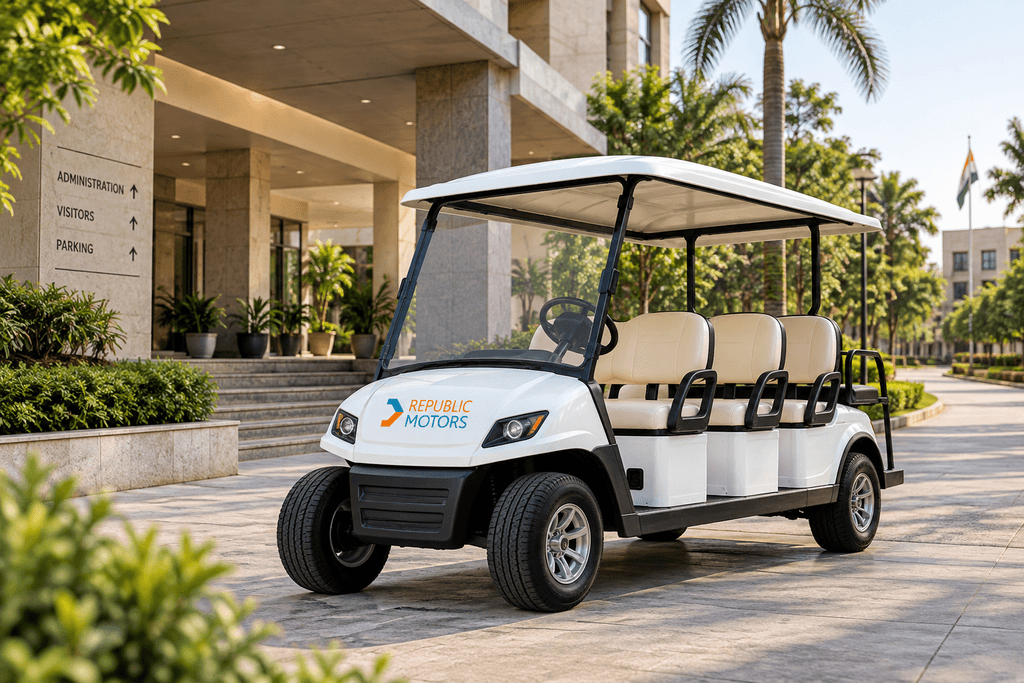
Choosing an electric golf cart manufacturer in India requires evaluating more than the vehicle’s price. Buyers should compare manufacturing capability, build quality, battery options, driving range, seating capacity, customization, warranty, and after-sales support before making a purchase.
Republic Motors is an Indian electric vehicle manufacturer that has been manufacturing vehicles since 2013. Its portfolio includes electric golf carts, passenger configurations, utility carts, and cargo solutions for commercial and institutional requirements. With 10,000+ vehicles delivered and 30+ models listed on its website, the company serves businesses looking for electric mobility solutions across India.
For hotels, resorts, golf courses, factories, universities, and other large properties, selecting the right manufacturer can help improve internal transportation, manage operating requirements and simplify long-term fleet maintenance.
1. Verify the Manufacturer’s Experience and Manufacturing Capability
The first step is to understand whether a company actually manufactures vehicles or primarily resells products from other suppliers. This distinction can affect customization options, technical support, spare parts availability, and accountability after delivery.
When evaluating an electric golf cart manufacturer, check:
- How long the company has operated in the electric vehicle industry.
- Whether it manufactures vehicles in-house or outsources production.
- Which golf cart models and configurations it currently offers.
- Whether it can provide product specifications and technical documentation.
- Whether manufacturing, inspection, and quality-control processes can be explained or demonstrated.
An experienced manufacturer should be able to discuss practical requirements such as seating capacity, operating hours, terrain, passenger movement, and expected usage frequency.
Republic Motors states that it designs and manufactures electric vehicles in India, with manufacturing operations associated with Punjab and Haryana. Buyers can use the company’s product information and sales consultation to assess whether its available configurations match their requirements.
2. Choose the Right Golf Cart Model and Seating Capacity
The appropriate golf cart depends on the number of passengers, available space, and frequency of use. Buying a larger vehicle than necessary may increase the initial investment, while choosing insufficient capacity can create operational difficulties.
| Golf cart configuration | What to evaluate before selecting it |
| 2-seater | Compact movement, golf course operations and limited-passenger requirements |
| 4-seater | Guest transportation and regular movement across medium-sized properties |
| 6-seater | Higher passenger capacity for resorts, campuses and larger facilities |
| 8-seater | Group transportation across extensive properties and designated internal routes |
| Utility or cargo cart | Movement of supplies, equipment, luggage or other permitted loads |
These are general selection guidelines rather than fixed rules. The best configuration depends on the actual route, passenger load, turning space and operating schedule.
Republic Motors offers RM Series golf carts in multiple seating configurations, including 2-, 4-, 6- and 8-seater options. Buyers should compare the specifications of the exact model before requesting a quotation.
3. Compare Battery Options, Range and Charging Requirements
Battery performance directly affects how an electric golf cart fits into daily operations. However, a manufacturer’s stated range should not be treated as a guaranteed result under every condition.
Ask the manufacturer to clarify the following:
- Battery type: Compare available lead-acid and lithium-ion configurations.
- Usable range: Understand the expected distance per charge under your operating conditions.
- Charging time: Confirm how long the selected battery takes to recharge.
- Battery warranty: Check the coverage period, exclusions and replacement terms.
- Charging arrangements: Determine whether your property has a suitable, safe charging location.
Actual range can vary with passenger or cargo load, terrain, driving behaviour, battery condition and operating conditions. A cart travelling short distances on level paths may have different requirements from one operating throughout a large industrial facility.
Republic Motors lists lead-acid and lithium-ion battery options for selected golf cart models. Before purchasing, request the latest specification sheet for your chosen configuration and confirm the battery capacity, charging time and expected range directly with the company.
4. Evaluate Build Quality and Suitability for Indian Conditions
A golf cart must suit the environment in which it will operate. Smooth resort pathways, golf course routes, campus roads and industrial premises can present different requirements.
During manufacturer evaluation, examine:
- Frame construction and overall build quality.
- Seating comfort and passenger entry and exit.
- Braking performance and steering response.
- Ground clearance and suitability for the intended surface.
- Tyres, suspension and other relevant components.
- Weather protection and available accessories.
- Ease of inspection, servicing and replacement of components.
If possible, arrange a demonstration or inspect a representative vehicle. Ask the supplier to explain any operating limitations, recommended maintenance and suitability for your site.
Do not rely on general claims such as “heavy-duty” or “built for all terrains” without checking the actual vehicle specifications. A cart suitable for paved internal roads may not be appropriate for rough, steep or uneven terrain.
5. Check Customization Options for Your Business
Standard golf cart configurations may not meet every operational requirement. Hotels, resorts, hospitals, factories and institutional campuses may need different seating arrangements, storage solutions or accessories.
Before selecting a manufacturer, discuss whether it can support requirements such as:
- Passenger seating configurations.
- Cargo or utility arrangements.
- Weather protection and enclosures.
- Luggage or equipment transportation.
- Colour and branding requirements.
- Site-specific accessories and operational features.
Customization should be evaluated against safety, functionality, delivery timelines and maintenance needs. Ask which modifications are available, which affect the quoted price and whether they change the vehicle’s specifications or warranty.
Republic Motors offers passenger golf carts alongside utility, cargo and customized electric vehicle solutions. Businesses can explain their operational requirements to the company before deciding whether a standard model or a customized configuration is more suitable.
6. Understand the Total Cost, Not Just the Purchase Price
The lowest quotation does not always represent the best long-term value. Businesses should compare the initial purchase price with the expected costs of operating and maintaining the vehicle.
Consider these factors when comparing quotations:
- Vehicle price and applicable taxes.
- Battery type and replacement costs.
- Electricity consumption and charging arrangements.
- Scheduled maintenance and spare parts.
- Warranty coverage and service charges.
- Delivery, installation or commissioning requirements, where applicable.
- Expected operating life and downtime considerations.
Ask every shortlisted manufacturer to quote comparable configurations. A quotation for a basic model should not be compared directly with one that includes a different battery, additional accessories or a broader warranty.
Electric golf carts can reduce dependence on petrol or diesel for suitable internal transportation tasks. However, actual savings depend on purchase cost, usage, electricity tariffs, maintenance, battery replacement and the alternative vehicle being compared.
A practical cost comparison should use your estimated daily distance, operating hours and fleet size rather than relying on a generic savings percentage.
7. Compare Warranty and After-Sales Support
After-sales service is an important consideration when a golf cart supports daily business operations. Delays in repairs or parts availability can interrupt passenger transportation and internal logistics.
Before placing an order, ask the manufacturer:
- What warranty applies to the vehicle and battery separately?
- Which parts and labour costs are covered?
- How can service requests be raised?
- Are spare parts available for the selected model?
- What maintenance schedule is recommended?
- What support is available at your location?
- What happens if a vehicle needs an extended repair?
Get warranty terms and service commitments in writing. Do not assume that every model has identical coverage or that all service work is included in the purchase price.
Republic Motors highlights after-sales support and spare parts assistance as part of its electric vehicle offering. Buyers should confirm the service arrangements, response expectations and warranty terms applicable to their specific model and location.
8. Manufacturer vs Dealer: Which Should You Choose?
Both manufacturers and dealers can be suitable purchasing channels, but buyers should understand the differences before making a decision.
| Evaluation factor | Direct manufacturer | Dealer or reseller |
| Product specifications | Can explain its manufactured models and configurations | Depends on the supplier’s product knowledge |
| Customization | May offer direct discussion of manufacturing options | Depends on the manufacturer’s arrangements |
| Pricing | May provide a direct quotation for the selected configuration | May include dealer-specific pricing or services |
| Technical support | Confirm the manufacturer’s service process | Confirm who handles repairs and warranty claims |
| Product availability | Confirm production and delivery timelines | Confirm available stock and delivery arrangements |
Neither channel is automatically better in every situation. The important factors are product authenticity, transparent pricing, written warranty terms, delivery commitments and reliable service.
For customized fleets or larger orders, direct communication with a manufacturer can make it easier to discuss technical requirements and confirm whether a proposed configuration is feasible.
9. Use a Pre-Purchase Checklist Before Finalizing the Order
Before selecting an electric golf cart manufacturer in India, review these points with your team:
- Define the intended use and daily operating schedule.
- Estimate passenger capacity or cargo requirements.
- Measure the available route width, turning areas and storage space.
- Compare the specifications of at least the relevant shortlisted models.
- Confirm battery type, range and charging requirements.
- Request a detailed quotation with the selected accessories.
- Verify warranty, spare parts and after-sales arrangements.
- Check production, delivery and payment terms.
- Arrange a product demonstration where practical.
- Obtain the final specifications and agreed terms in writing.
For fleet purchases, it is also useful to nominate one person to coordinate technical requirements, procurement, charging infrastructure and service arrangements. This reduces the risk of selecting a vehicle based only on its appearance or headline price.
Choose the Right Electric Golf Cart for Your Business
Selecting a suitable manufacturer involves balancing product quality, operating requirements, customization, total ownership cost and long-term support. A structured comparison helps businesses make a decision based on their actual needs rather than choosing solely on price.
Republic Motors offers electric golf carts in multiple seating configurations, together with utility and cargo solutions for different commercial applications. Businesses can explore the available models, review the specifications, and discuss their requirements before selecting a suitable configuration.
If you are evaluating an electric golf cart for a hotel, resort, golf course, campus, factory or other commercial property, visit the Republic Motors website to explore its product range and contact the team for a quotation based on your requirements.